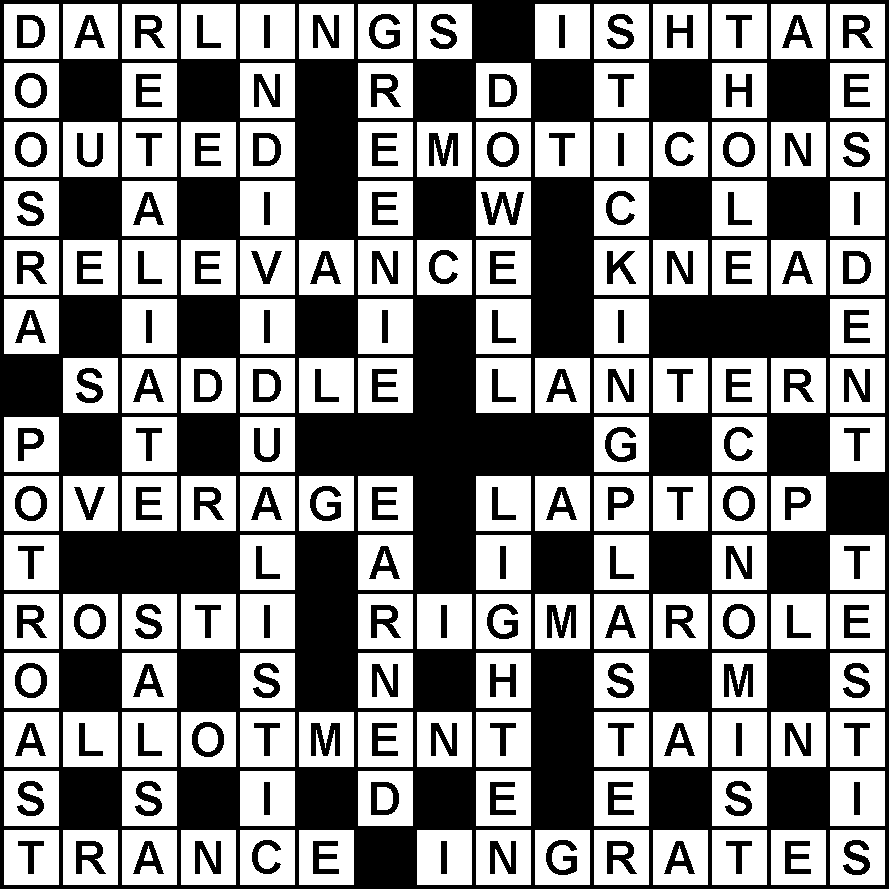
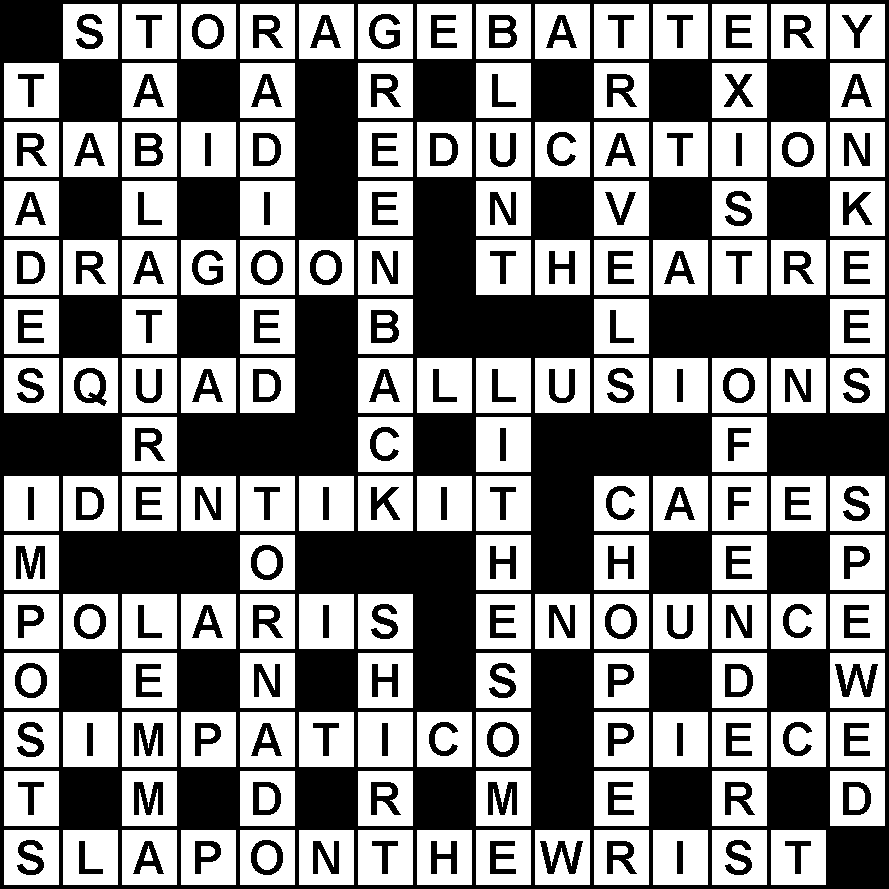
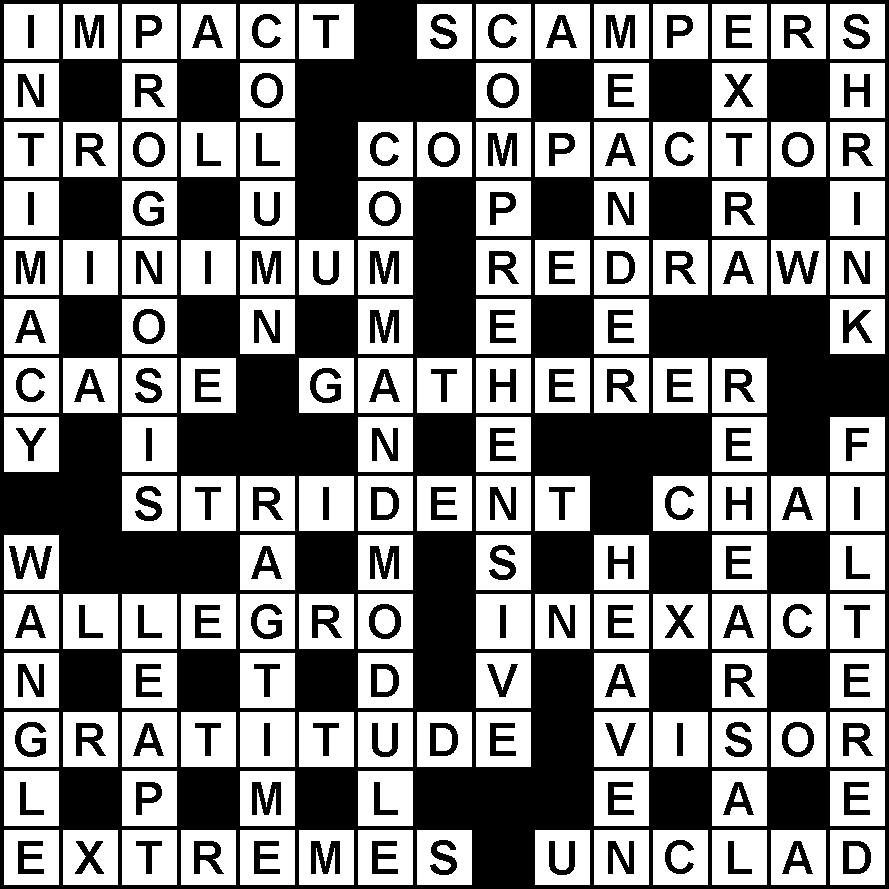
(click on the clue number to see the hint)
Click on underlined text for explanation of terms.
Need more hints for these or other clues? Just leave a reply below.
The structure of the answer involves either letters placed outside other letters, or letters placed inside other letters. Which type of container clue is determined by an appropriate container indicator.
The structure of the answer involves either letters placed outside other letters, or letters placed inside other letters. Which type of container clue is determined by an appropriate container indicator.
The structure of the answer involves either letters placed outside other letters, or letters placed inside other letters. Which type of container clue is determined by an appropriate container indicator.
The answer is found by removing a letter, letters, or a word (either found directly in the clue or derived) from a word or words (or their synonyms). Subtractions involving synonyms must be done with contiguous letters, that is, a word will subtract directly unless specifically indicated. A subtraction indicator is present to initiate the action.
A pointer that signifies the placing of one or more parts of a clue (or their equivalents) around the OUTSIDE of one or more parts of a clue (or their equivalents).
Examples: holding, keeping, embracing - anything that creates the image of containment.
The structure of the answer involves either letters placed outside other letters, or letters placed inside other letters. Which type of container clue is determined by an appropriate container indicator.
The structure of the answer involves either letters placed outside other letters, or letters placed inside other letters. Which type of container clue is determined by an appropriate container indicator.
The answer is found by using the sound of a word or phrase. Sounds-like indicators point the way.
A pointer that signifies the placing of one or more parts of a clue (or their equivalents) on the INSIDE of one or more parts of a clue (or their equivalents).
Examples: held by, kept by, embraced by - anything that creates the image of being contained.
A pointer that signifies the placing of one or more parts of a clue (or their equivalents) around the OUTSIDE of one or more parts of a clue (or their equivalents).
Examples: holding, keeping, embracing - anything that creates the image of containment.
The answer is found by butting together parts defined in the wordplay. There may be some positional indicators that change the order of these parts.
The answer is hidden among the words of the clue. No spare words should be present. A suitable hidden indicator will point to the buried text.
Examples: part of, associated with, types of.
The structure of the answer involves either letters placed outside other letters, or letters placed inside other letters. Which type of container clue is determined by an appropriate container indicator.
The answer is found by butting together parts defined in the wordplay. There may be some positional indicators that change the order of these parts.
Either a mixture of letters is placed inside or outside other letters, or letters are placed inside or outside a mixture of letters. An anagram indicator and containment indicator will be present.
The answer is a jumbling of letters except for the initial or final letter of the anagram fodder. An anagram indicator and truncation indicator will be present.
A question mark has been used to indicate "language abuse", that is, a word or words in a clue are used in a technically incorrect way, but the meaning can be still inferred.
Example: A indeed (?) could mean to insert A inside deed.
The answer is hidden among the words of the clue. No spare words should be present. A suitable hidden indicator will point to the buried text.
Examples: part of, associated with, types of.
Either a mixture of letters is placed inside or outside other letters, or letters are placed inside or outside a mixture of letters. An anagram indicator and containment indicator will be present.

 I was reminded a few weeks back that as a setter I must not only cater for a huge range of solvers with different abilities but consider where people may be at in their lives and what experiences they may have had. Even though I look at words as being made up of other words and letters, the words and answers I use, and the clues I phrase can mean different things to different people. I’ve often wondered whether I could get into trouble for writing a cryptic clue that reads as a disparaging remark yet the answer and how it’s derived bear no resemblance to the original clue. In theory the clue is a puzzle, and only the definition (and answer) means something, but a casual reader could easily be offended if they didn’t have cryptic insight. Some publications have crossword rules about acceptable answers that include the non-use of diseases etc and anything that may cause offence, which is rather broad. A cryptic crossword setter may get away with a risque word as the right clue will soften the blow creating a kind of inside joke.


 I’ve been solving cryptic crosswords since I was 15 – that’s almost 40 years. I compiled my first published crossword in my 20s in a staff magazine and considered myself a professional setter in my early 30s. Those early compiling days were interesting, not just because of the lack of technology, but because my setting skill relied almost totally on what I’d gleaned from solving. This had a profound impact on the crosswords I designed and the clues I wrote. It’s amazing how little I had really picked up as a solver, something I see repeated regularly when experienced solvers have a go at setting. Even UK Times solvers-turned-setters who have been fed the most rigid clues for decades can start using questionable devices they have never seen used before. How can/does this happen? A solver will break down clues, apply indicators, substitute abbreviations, extract letter fragments, all without really understanding what’s happening – they don’t need to understand to solve, they just need be able to piece together a wordplay and find an answer. Thus, as a setter, an anagram indicator becomes just a mechanism to change letters and its tense or position grammatically gets totally overlooked; or an indirect anagram is used even though as a solver they had never seen one used in a major publication. The use of obscure abbreviations is a common trap, where the novice setter has taken the use of some abbreviations in their favourite crossword as an endorsement of all abbreviations, no matter the source or usage. The lesson? If you want to have a go at setting, don’t totally rely on your solving experience to guide you – read books by professional setters, expand you solving horizon, read crossword blogs where solvers write about their concerns with clues, and get at least one person with lots of solving experience to test your work. This last piece of advice only works if you are prepared to act on any constructive feedback given, which is possibly the biggest stumbling block in becoming a respected setter.
 Recently I was chuffed to find a reference to The Stickler Weekly in

