
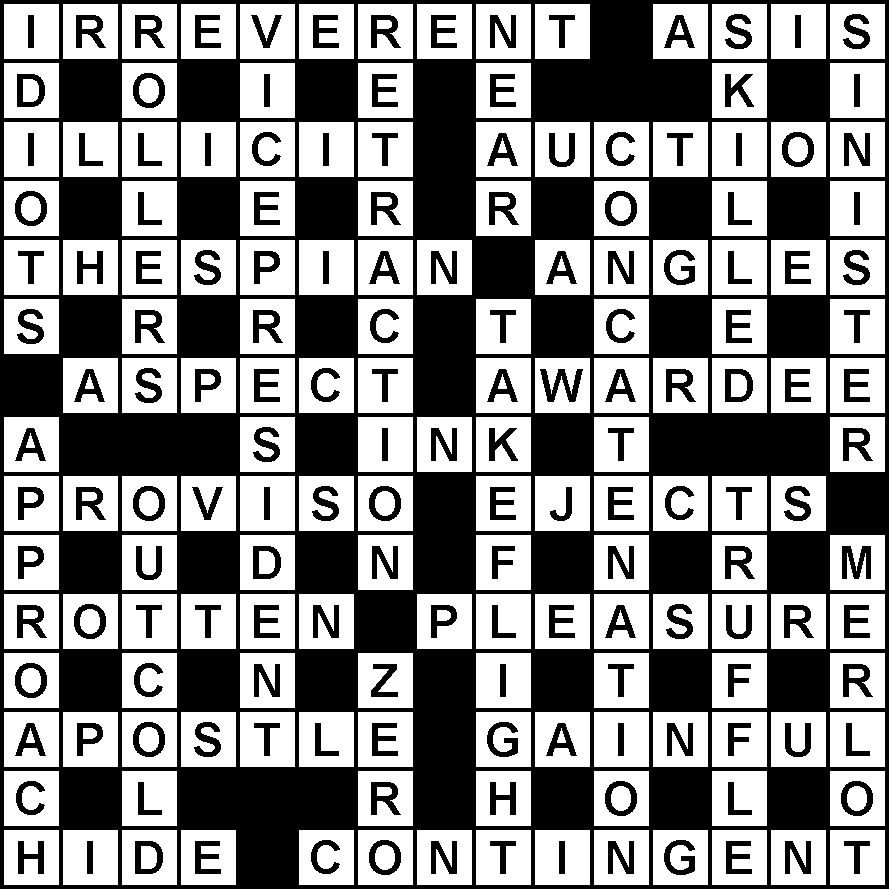
 The internet is a fascinating place. It allows all people with a connection the ability to get involved, either as an originator or a contributor, or both. It shouldn’t surprise us that there are thousands of niches out there just waiting for interested people to find them. Recently a couple of overseas crossword friends pointed me to the Kickstarter website where projects of all shapes and sizes are birthed. I was surprised to find a number of crossword projects (almost all American), that sometimes involved a theme, or a collaborative effort, or a set of crosswords by just one person. The premise is simple: raise funds for a defined project over a relatively short period and reward contributors differently depending on their pledge. What really struck me was the response to a US cryptic crossword Kickstarter project last year which raised almost double the minimum requirement in just 30 days. A total of 240 people pledged a combined US$7,397 for a set of 12 cryptic puzzles. The US doesn’t have any home-grown daily cryptics and just one home-grown weekly cryptic, so this response suggests they may be a demand beyond what is currently available.
Would you support a Stickler Kickstarter project?
| Across | Answers and Clues | Explanations |
| 1 | IRREVERENT | |
| Disrespectful one, right, always involved in division (10) | I + [(R + EVER) inside RENT] | |
| 6 | AS IS | |
| Foundation not opening in the current state (2,2) | (B)ASIS | |
| 9 | ILLICIT | |
| In poor health, I mention clipped criminal (7) | ILL + I + CIT(E) | |
| 10 | AUCTION | |
| Litigation blocking uranium’s public sale (7) | ACTION outside U | |
| 12 | THESPIAN | |
| The reel shown about a person in the acting business (8) | (THE + SPIN) outside A | |
| 13 | ANGLES | |
| Attempts to catch one from school with crooks (6) | Double Definition | |
| 15 | ASPECT | |
| View held by people originally in a religious cult (6) | (P)EOPLE inside ( A + SECT) | |
| 16 | AWARDEE | |
| One honoured a short act about war (7) | [A + DEE(D)] outside WAR | |
| 18 | INK | |
| Writing material concerned with last part of book (3) | IN + BOO(K) | |
| 19 | PROVISO | |
| Specialist is finishing against circuit rider (7) | PRO + (IS after V) + O | |
| 21 | EJECTS | |
| Discharges energy generated by carbon in aeroplanes (6) | E + (C inside JETS) | |
| 24 | ROTTEN | |
| Corrupt attorney losing case badly (6) | Anagram of (A)TTORNE(Y) | |
| 25 | PLEASURE | |
| The French like being held during pure gratification (8) | (LE + AS) inside PURE | |
| 27 | APOSTLE | |
| Preacher consumed by drink is put on duty (7) | POST inside ALE | |
| 28 | GAINFUL | |
| Moneymaking in finance initially accepted by old part of Europe (7) | [IN + (F)INANCE] inside GAUL | |
| 29 | HIDE | |
| Shelter fell (4) | Double Definition | |
| 30 | CONTINGENT | |
| Military force in Gulf primarily used to bolster capacity (10) | [IN + (G)ULF] inside CONTENT | |
| Down | Answers and Clues | Explanations |
| 1 | IDIOTS | |
| One by one embraced by…clowns? (6) | I + (I inside DOTS) | |
| 2 | ROLLERS | |
| They may be used to paint expensive cars (7) | Double Definition | |
| 3 | VICE PRESIDENT | |
| Pressure after failing shown by local executive (4,9) | (P after VICE) + RESIDENT | |
| 4 | RETRACTION | |
| Withdrawal of a statement regarding purchase (10) | RE + TRACTION | |
| 5 | NEAR | |
| Passengers in plane are not far away (4) | plaNE ARe | |
| 7 | SKILLED | |
| Expert witness finally finished off (7) | WITNES(S) + KILLED | |
| 8 | SINISTER | |
| Order member around home threatening harm (8) | SISTER outside IN | |
| 11 | CONCATENATION | |
| Caught pet kept by one lot of people with chain (13) | C + (CAT inside ONE) + NATION | |
| 14 | TAKE FLIGHT | |
| King, in daring act, set up beacon to get away (4,6) | K inside (FEAT reversed) + LIGHT | |
| 17 | APPROACH | |
| Native American not totally grasping professional’s technique (8) | (APACH)E oustide PRO | |
| 20 | OUT COLD | |
| Boxer’s second repaired cut on veteran in an unconscious state (3,4) | B(O)XER + anagram of CUT + OLD | |
| 22 | TRUFFLE | |
| Time to put out sweet (7) | T + RUFFLE | |
| 23 | MERLOT | |
| Drink is not accepted by miser with group (6) | (MISER minus IS) + LOT | |
| 26 | ZERO | |
| A very low temperature froze road partially (4) | froZE ROad |


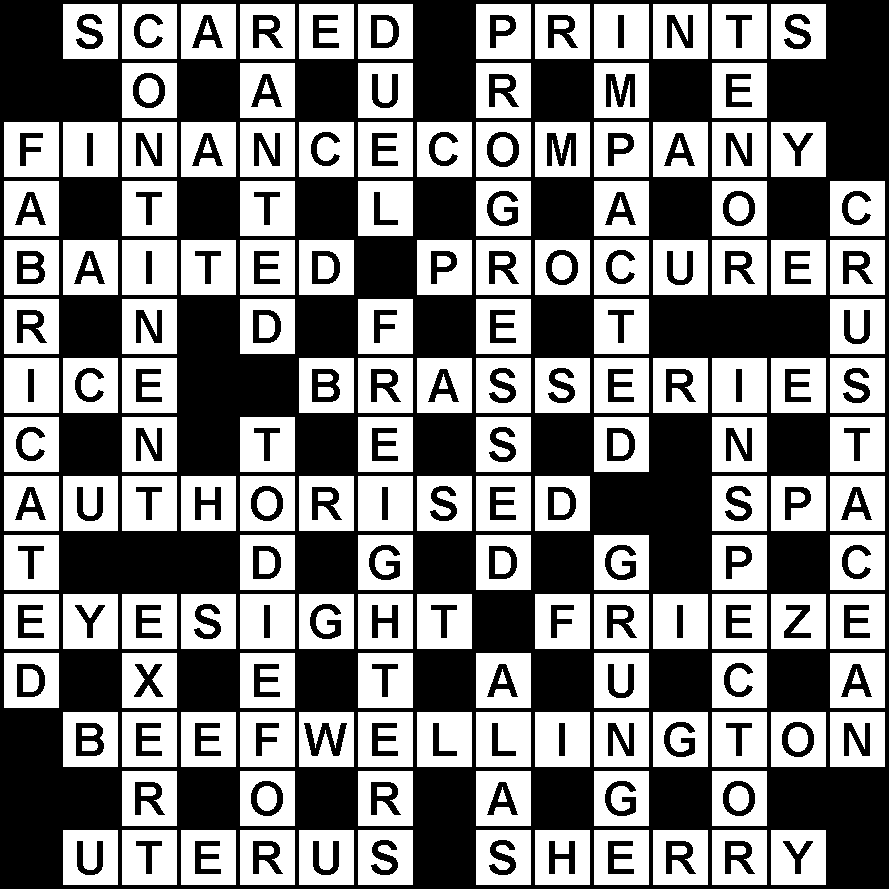 What do you see when you look at the word INSPECTOR (15-down)? If I asked you for clueing ideas, what would you come up with? IN + SPECTOR (Beatles record producer), or maybe anagrams like PC IN STORE or PR SECTION? The truth is, with a word like this, there will be dozens of potential wordplays, so how do you pick one? The starting point is rarely the wordplay (although word selection may be based on wordplay availability), it’s the definition. As a cryptic clue is the (hopefully seamless) combination of definition and wordplay, attention must be given to finding as many options as possible in order to end up with the best clue. So, the first task is looking up every reference and reading INSPECTOR entries, arming yourself with as much fodder as possible: the more you have the easier it will be to join with one of the many wordplays available. INSPECTOR has its limitations – it can only be a noun, for example – but nonetheless there are over 20 thesaurus entries, general inspectors (whose who inspect in any way), appointed inspectors (those who inspect as a job), and ranked inspectors (in the police force etc), so a lot to work with. Next, it’s time to explore the wordplays to see if any of them have a natural relationship with a possible definition. For example, an anagram of PC IN STORE would tie in nicely with ‘(police) officer’ thus: “PC in store updated senior officer (9)”. The aim here is to give the solver a complete picture so that breaking down the clue into wordplay and definition isn’t that obvious. Sometimes their isn’t a seamless marriage between definition and wordplay, which means tinkering with the definition, finding new wordplays or (last resort) settling on a clue that you know is deficient. It all takes time but is well worth the effort.
 As a setter, I make it my business to keep track of what’s happening in the world of crosswords. This means visiting other setters’ websites, solving various crosswords and reading crossword blogs. We don’t host many of these in Australia, but occasionally something turns up that catches my attention. This week a short discussion erupted on the

