
 A couple of weeks ago I talked about the unusual clue 0.9 (3) and how it worked. I also mentioned that it took some liberties but ultimately provided enough info for the solver as long as the clue was read out. For success, the “.” must be read as “point”, and in the context of the clue that was the only possibility, however, “.” in other contexts (such as a period at the end of a sentence) wouldn’t work in the same way. So, here we have “.” = “point” = compass direction = “N” (the abbreviation for “north”). In crossword terms, this is an indirect reference, one that can be resolved if a number of right steps are taken, but where there’s no direct relationship between the element in the wordplay and the desired element in the solution. That is, nowhere will you find “.” = N, unlike in a direct reference where a synonym is needed or an abbreviation is used. Indirect references, however, are used all the time in cryptics: Business = company = CO; Way = street = ST; Good man = saint = ST; student = learner = L. Setters need to make up their own minds on whether to use such references, but as they have become crosswordese and therefore recognisable and accepted by solvers generally, they are used all the time.
There’s another type of indirect reference that pops up every now and then involving instructional synonyms. That is, a word or words must be translated into a term, and then that term becomes part of the wordplay. Here’s an example: Bored with the writer following a smear? (6) [down clue] Here, “Bored” must be translated to “fed up”, and the result can then be DEF. [DEF + (ME after A) = DEFAME] It’s super tricky and can only be employed when the synonyms involved leave little doubt as to what’s needed. That is, if “fed up” isn’t in the first couple of synonyms thought of when the solver contemplates “bored”, then it’s no good. This type of technique always leads to at least a two-word synonym (needed to be instructional) which adds complexity to the solving process – even more reason to ensure a question mark is used to indicate to solvers that “language abuse” is in play. Here’s a published example that makes the solver’s job hard IMO:
Limited volume as a precaution to vend car? (7) Here, “as a precaution” must be translated to “in case” before the wordplay is actioned, making this a container and contents clue. [(BOO)K inside CASE = CABOOSE] (Remember, in both examples, there’s no indication that anything more than a synonym is required, so even if the solver works out the synonym, there’s no guarantee they’ll take the extra leap. Nine times out of ten, the trickiness will reveal itself in hindsight.) To me, “as a precaution” doesn’t scream “in case”, which it needs to in order to accomplish its goal. Add to that the need to shorten a synonym before use, and we have a really difficult clue. At least the question mark is present, which can be is effective as long as the setter is consistent with its use.
To summarise, any indirect references in clues need to be, to quote Basil Fawlty, “bleedin’ obvious” to be acceptable.
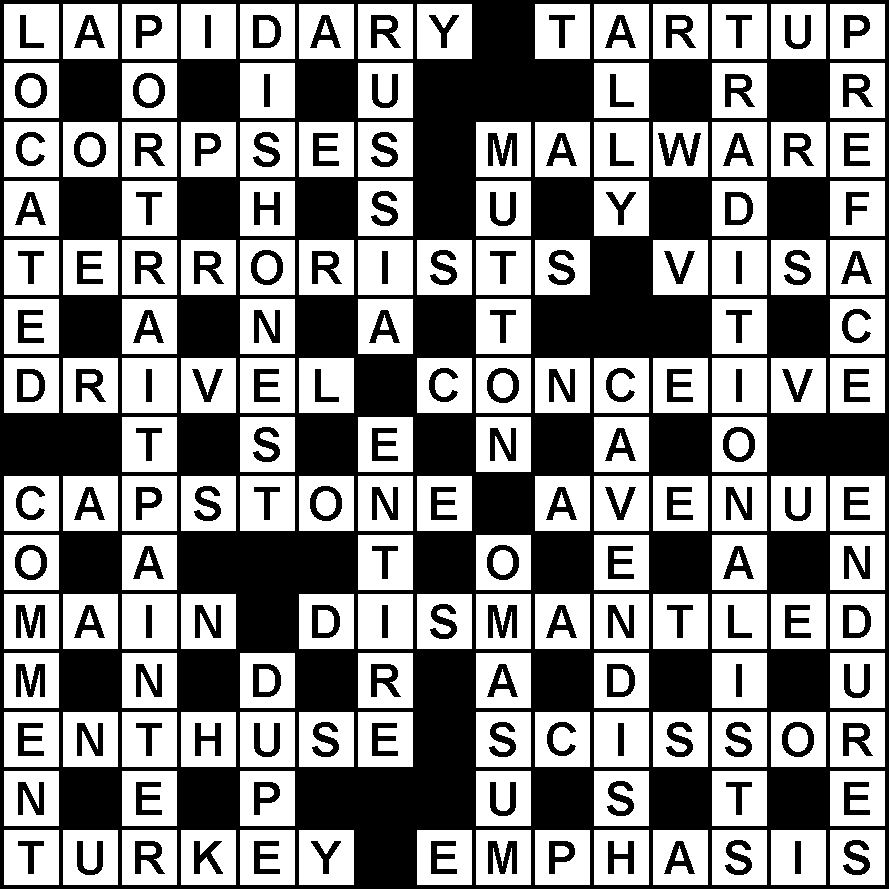
| Across | Answers and Clues | Explanations |
| 1 | LAPIDARY | |
| Stoneworker fixed a drip in lodge (8) | Anagram of A DRIP inside LAY | |
| 5 | TART UP | |
| Improve the look of black sheep? (4,2) | TAR + TUP | |
| 9 | CORPSES | |
| Correspondent’s extra information processed internally by central school bodies (7) | PS inside (CORE + S) | |
| 10 | MALWARE | |
| Conflict admitted by male is damaging programs (7) | WAR inside MALE | |
| 11 | TERRORISTS | |
| “Revolutionaries” could be different to “stirrers” (10) | Anagram of TO STIRRERS | |
| 12 | VISA | |
| Vinyl primarily is a plastic (4) | (V)INYL + IS + A | |
| 13 | DRIVEL | |
| Bull left after steer (6) | L after DRIVE | |
| 14 | CONCEIVE | |
| Once restricted by copyright I have to think (8) | ONCE inside (C + IVE) | |
| 17 | CAPSTONE | |
| One completing revision of pacts is coping (8) | ONe after anagram of PACTS | |
| 18 | AVENUE | |
| Approach a sports arena perhaps (6) | A + VENUE | |
| 21 | MAIN | |
| Person guarding one chief (4) | MAN outside I | |
| 22 | DISMANTLED | |
| Bearing carried by slow worker was first pulled apart (10) | (S inside DIM) + ANT + LED | |
| 24 | ENTHUSE | |
| Switch on broadcast then exercise (7) | Anagram of THEN + USE | |
| 25 | SCISSOR | |
| Cross is roughly cut with sharp blades (7) | Anagram of CROSS IS | |
| 26 | TURKEY | |
| Track heading west maintained by important country (6) | RUT reversed + KEY | |
| 27 | EMPHASIS | |
| Import hemp cultivated without additives (8) | Anagram of HEMP + AS IS | |
| Down | Answers and Clues | Explanations |
| 1 | LOCATED | |
| Found ingredients of well-made taco left over (7) | wellmaDE TACO Left reversed | |
| 2 | PORTRAIT PAINTER | |
| Artist’s feature on suffering handled by carrier (8,7) | (TRAIT + PAIN) inside PORTER | |
| 3 | DISHONEST | |
| Criminal liked person with counterfeit notes (9) | DISH + anagram of NOTES | |
| 4 | RUSSIA | |
| Elevated area of Australia is surprising country (6) | australiA IS SURprising reversed | |
| 6 | ALLY | |
| Friend is one from the lead in car race (4) | RALLY minus R | |
| 7 | TRADITIONALISTS | |
| Conservatives, those who think logically about Diana after some time (15) | (RATIONALISTS outside DI) after T | |
| 8 | PREFACE | |
| Quiet one handling referee’s introduction (7) | (P + ACE) outside REF | |
| 10 | MUTTON | |
| One mostly after dog meat (6) | (ON)E after MUTT | |
| 15 | CAVENDISH | |
| Cake of tobacco – sell one in container of brass (9) | (VEND + I) inside CASH | |
| 16 | ENTIRE | |
| Middle section of trench next to bore is full (6) | TR(EN)CH + TIRE | |
| 17 | COMMENT | |
| Married men in bed say something (7) | (M + MEN) inside COT | |
| 19 | ENDURES | |
| Objective user misread faces (7) | END + anagram of USER | |
| 20 | OMASUM | |
| Woman’s enlarged heart may be linked to problem with stomach? (6) | W(OMA)N + SUM | |
| 23 | DUPE | |
| Pressure handled by outstanding victim (4) | P inside DUE |


 I’ve written a number of things in this spot about anagrams. First, I like them. Possibly seen as a setter’s lazy option, I’m convinced that a well-disguised anagram is one of the best forms of cryptic clue. It’s easy to understand for all, newbies and experienced solvers, and its nature offers a huge amount of variety, as it can be used standalone or in combination with other devices. There are more anagram indicators than for any other device, allowing a setter great scope. Second, not all anagrams are equal. Some anagrams are so obvious that in certain publications no anagram indicator is used; some anagrams use such obscure or tangential indicators that it’s almost in hindsight that the solver realises an anagram is in play; others are created with care and use contextual indicators in well-crafted wordplay and so they don’t fall into the bleeding obvious category. In the Stickler Weekly I try not to use more than two full anagrams (anagrams that result in the entire answer), but have no concerns about using partial anagrams if they suit the clues. I’m always aware of the total number of anagrams but consider a clue that uses multiple devices including an anagram to be far more difficult than one that’s a full anagram. As someone who tries to subscribe to the no etymology crossover rule, I have less to work with in wordplays and rely on the use of anagrams in its many forms to add variety to wordplays.
 The Daily Telegraph once did an article about me and cryptics at my home at the time in Thornleigh, and asked if there was someone around who could pose as they took a photo of me explaining how cryptics worked. I grabbed my young neighbour and he played his part. From that time, 15 years ago, my student and I never spoke of cryptics and my family moved away a relatively short time after and we didn’t keep up the relationship. Things changed a few months back. I received an email from the former neighbour, now in his late 20s, asking about writing cryptics. (When I knew this neighbour, he was probably about 14 years old.) It was difficult at first thinking of him as fully grown-up, as that wasn’t my memory of him, but there was no doubt from his emails that he had a pretty good grasp of cryptic setting and the fact that he approached me for help demonstrated a certain level of maturity. It turns out our brief time in the spotlight did nothing to spark an interest in cryptics, as he didn’t take up solving until a few years ago and very quickly migrated to having a go at writing clues and now crosswords.


