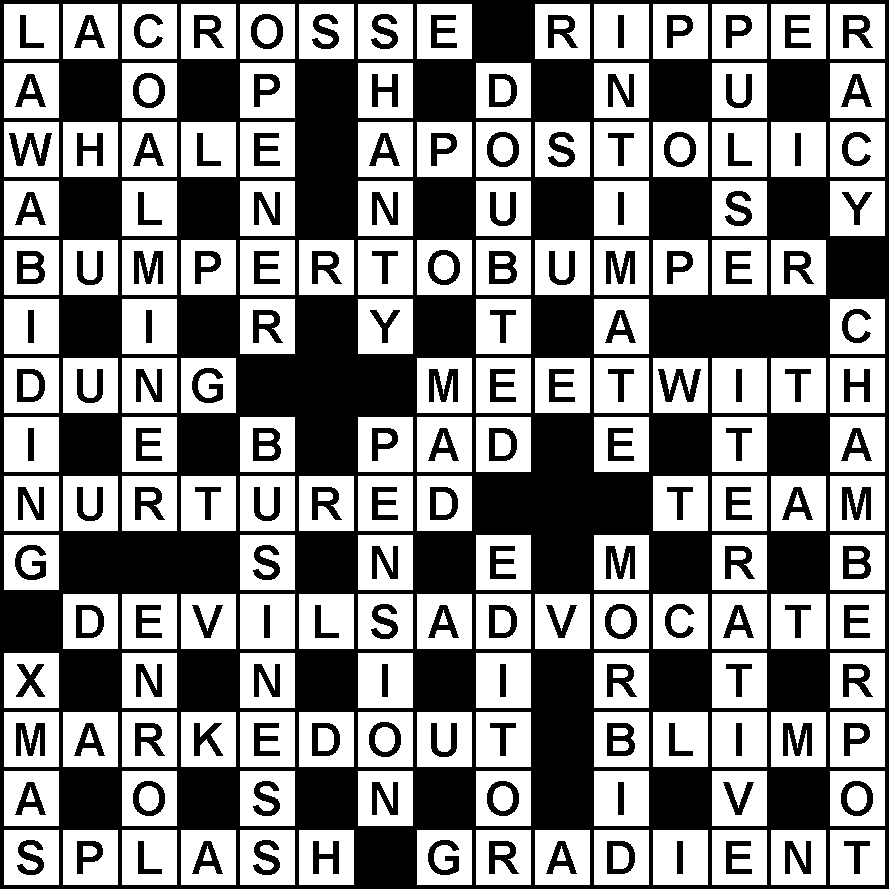
The Stickler Weekly 107 Clue Hints

(click on the clue number to see the hint)

Click on underlined text for explanation of terms.

Need more hints for these or other clues? Just leave a reply below.


1-across


9-across

10-across

13-across


23-across

27-across

28-across


4-down


8-down

12-down

14-down

16-down

17-down


25-down

The structure of the answer involves either letters placed outside other letters, or letters placed inside other letters. Which type of container clue is determined by an appropriate container indicator.
A pointer that signifies the placing of one or more parts of a clue (or their equivalents) around the OUTSIDE of one or more parts of a clue (or their equivalents).

Examples: holding, keeping, embracing - anything that creates the image of containment.

Punctuation generally should be ignored - always consider how a clue reads without punctuation.
The answer is found by butting together parts defined in the wordplay. There may be some positional indicators that change the order of these parts.
Either a mixture of letters is placed inside or outside other letters, or letters are placed inside or outside a mixture of letters. An anagram indicator and containment indicator will be present.
A word or phrase that defines the answer. All cryptic clues usually have a minimum of one definition which will be located at the beginning or end of the clue.
The answer is found by butting together parts defined in the wordplay. There may be some positional indicators that change the order of these parts.
The answer is found by removing a letter, letters, or a word (either found directly in the clue or derived) from a word or words (or their synonyms). Subtractions involving synonyms must be done with contiguous letters, that is, a word will subtract directly unless specifically indicated. A subtraction indicator is present to initiate the action.
The answer is found by butting together parts defined in the wordplay. There may be some positional indicators that change the order of these parts.
A question mark has been used to indicate "language abuse", that is, a word or words in a clue are used in a technically incorrect way, but the meaning can be still inferred.

Example: A indeed (?) could mean to insert A inside deed.

The structure of the answer involves either letters placed outside other letters, or letters placed inside other letters. Which type of container clue is determined by an appropriate container indicator.
A word or phrase that defines the answer. All cryptic clues usually have a minimum of one definition which will be located at the beginning or end of the clue.
The answer is hidden among the words of the clue. No spare words should be present. A suitable hidden indicator will point to the buried text.

Examples: part of, associated with, types of.

The answer is found by removing a letter, letters, or a word (either found directly in the clue or derived) from a word or words (or their synonyms). Subtractions involving synonyms must be done with contiguous letters, that is, a word will subtract directly unless specifically indicated. A subtraction indicator is present to initiate the action.
Posted in Stickler Weekly Clue Help, The Stickler | Tagged , , , | 7 Comments

The Stickler Weekly 107 Overseas Help

Welcome all cryptic crossword solvers.

Some cryptic crosswords are tough purely because local lingo is used and not understood by all, especially those living outside of Australia. This post seeks to fill this vernacular gap.

The clues listed here may contain a component not familiar to all outside of Australia.

(click on the clue number to see the inside information)


1-down

Like to add something I’ve missed to help others, or comment on a meaning, term or expression? Please leave a reply below.

Posted in Stickler Weekly Clue Help, The Stickler | Tagged , , | Comments Off on The Stickler Weekly 107 Overseas Help

The Stickler Weekly 106 Solution

Do you ever come across something in cryptics that seems wrong or not quite right, but, as it is published in a newspaper and doesn’t get criticised, you assume it’s not an error, instead that you are missing something? For me, if an experienced solver can’t see what’s happening, even after getting the answer, then the explanation better be rock solid and elicit an ah-ha moment, or the device has no right being used. Here’s an example: I could never understand why the use of ” ‘s ” was acceptable in circumstances where it appeared it was being used in a possessive sense. It had no role, it appeared, except to improve or enable suitable surface reading of a clue. I just accepted it as lazy cluing and began to ignore it after a while. That was until someone explained that the ” ‘s ” wasn’t possessive, it equated to “is” or “has”, which was a valid reading of the device and that it therefore had a role in the clue. Now I know, I accept it and use it with the full knowledge of how it works so that I don’t misuse it and can explain it if necessary. Blindly using cryptic devices without full understanding of how they are used will lead to faulty clues. Recently another cryptic chestnut came up in a UK blog that I’d never really understood: the ellipsis, not the “…” kind, but grammar kind. I’ll talk about it next week.

Across Answers and Clues Explanations
1 SATIRISE
Glossy shortened swell parody (8) (SATI)N + RISE
5 CEASES
Ecstasy, in certain situations, stops working (6) E inside CASES
10 ELBOW
Unorthodox bowler mostly with sharp turn (5) Anagram of (BOWLE)R
11 ADAPTABLE
Flexible cushion stuffed back into a piece of furniture (9) (PAD reversed) inside (A + TABLE)
12 INTERCHANGE
One to be brought to justice in centre arranged trade (11) I + (HANG inside anagram of CENTRE)
13 TAO
Members of junta outlined Chinese way to be followed (3) junTA Outlined
14 UNDERPERFORMED
Red prune, cultivated and developed, failed to live up to expectations (14) Anagram of RED PRUNE + FORMED
18 PHOTOSYNTHESIS
Tortured spy is honest about recent plant activity (14) Anagram of SPY IS HONEST outside HOT
22 ODD
Extraordinary gathering backed closing of road (3) DO reversed + ROA(D)
23 IMPROVEMENT
I am in favour of people involved in vet’s recovery (11) IM + PRO + (MEN inside VET)
26 EXTENDING
Old friend, finishing after time, is carrying on (9) EX + (ENDING after T)
27 PLAIT
Do it at the end of curtailed play (5) IT after (PLA)Y
28 SURELY
Rules broken by day’s end without a doubt (6) Anagram of RULES + DA(Y)
29 STALLAGE
Fair cost everyone accepted in arena (8) ALL inside STAGE
 Down  Answers and Clues Explanations
1 SEE FIT
Choose it after raising of service charges (3,3) IT after (FEES reversed)
2 TIBETAN
Be imprisoned by giant mountain man, say (7) BE inside TITAN
3 ROWER
One who argues with crew member, perhaps (5) Double Definition
4 SLAP-HAPPY
Tour hospital in company of silly casual (4-5) (LAP + H) inside SAPPY
6 ENTRECOTE
Steak dish served in bed? Just the opposite (9) COT inside ENTREE
7 SUBITEM
Some food identified in problem as a minor detail (7) BITE inside SUM
8 STEROIDS
High-flyers not using a drug cheat’s supplements (8) A(STEROIDS)
9 LAWN
Grass mother pinched from officer of the court (4) LAWMAN minus MA
15 EMOTIONAL
Thrilling book about a lion in the wild (9) TOME reversed + anagram of A LION
16 RETHOUGHT
The rough prepared next to tee is considered from a new angle (9) Anagram of THE ROUGH + T
17 OPPOSERS
Models chasing theatre work may be adversaries (8) POSERS after OP
19 OLDSTER
Senior citizen died, leaving toddlers confused (7) Anagram of TODDLERS minus D
20 IKEBANA
Japanese art restriction accepted by big furniture retailer (7) BAN inside IKEA
21 STATUE
Make legal claim, taking into account tasteless articles and artwork (6) SUE outside TAT
24 PAIR
2 and 1 recorded in golf score (4) I inside PAR
25 EXPEL
Throw out selection of perspex pelmets (5) perspEX PELmets


Posted in Stickler Weekly Solutions, The Stickler | Tagged , , | 3 Comments

The Stickler Weekly 106

The Stickler for this week is now available. Please select your preferred solving format.

The solution to this puzzle will appear next week.

  Clue Hints for The Stickler Weekly 106
  Overseas Help for The Stickler Weekly 106
  Solution to The Stickler Weekly 105
  Invest in the Future of The Stickler

Please include comments or discussion about this crossword below.
Request help in the Clue Hints blog entry so all can see.

It’s a weekly crossword, so please don’t give/discuss any full answers until the solution is posted (such posts will be deleted/edited).

Enjoy!

The Stickler

Posted in Stickler Weekly Puzzles, The Stickler | Tagged , , , | Comments Off on The Stickler Weekly 106

The Stickler Weekly 106 Clue Hints

(click on the clue number to see the hint)

Click on underlined text for explanation of terms.

Need more hints for these or other clues? Just leave a reply below.


1-across


11-across

12-across

14-across

18-across

27-across

29-across


4-down

6-down

7-down


9-down

15-down

17-down


20-down

21-down


The structure of the answer involves either letters placed outside other letters, or letters placed inside other letters. Which type of container clue is determined by an appropriate container indicator.
The answer is a jumbling of letters except for the initial or final letter of the anagram fodder. An anagram indicator and truncation indicator will be present.
A word or series of words that signify a mixing-up of letters.

Examples: changed, at sea, confused, all over the place - anything that indicates change or jumbling.

Either a mixture of letters is placed inside or outside other letters, or letters are placed inside or outside a mixture of letters. An anagram indicator and containment indicator will be present.
The structure of the answer involves either letters placed outside other letters, or letters placed inside other letters. Which type of container clue is determined by an appropriate container indicator.
The clue has two parts, each one defining the answer without using cryptic devices. Ideally each definition should have no etymological relationship.
A word or phrase that defines the answer. All cryptic clues usually have a minimum of one definition which will be located at the beginning or end of the clue.
The structure of the answer involves either letters placed outside other letters, or letters placed inside other letters. Which type of container clue is determined by an appropriate container indicator.
The answer is found by removing a letter, letters, or a word (either found directly in the clue or derived) from a word or words (or their synonyms). Subtractions involving synonyms must be done with contiguous letters, that is, a word will subtract directly unless specifically indicated. A subtraction indicator is present to initiate the action.
A word or series of words that signify the turning around (across & down clues), or overturning (down clues only) of letters.

Examples: upset, reversed, retired, in withdrawal, over etc.

A type of clue that involves the mixing up of letters without the inclusion of a letter or letters. This clue will have an anagram indicator to signify jumbling and a subtraction indicator to signify the removal of a letter or letters.

A removed letter may be as seen in the clue, an abbreviation for a word in the clue, or the result of another cryptic device like taking the initial letter from a word. Removed letters may be a whole word as seen in a clue, the synonym of a word in the clue (if that synonym is contiguous within the anagram fodder), or the result of another cryptic device like taking the middle two letters from a word.

The structure of the answer involves either letters placed outside other letters, or letters placed inside other letters. Which type of container clue is determined by an appropriate container indicator.
Posted in Stickler Weekly Clue Help, The Stickler | Tagged , , , | Comments Off on The Stickler Weekly 106 Clue Hints

The Stickler Weekly 106 Overseas Help

Welcome all cryptic crossword solvers.

Some cryptic crosswords are tough purely because local lingo is used and not understood by all, especially those living outside of Australia. This post seeks to fill this vernacular gap.

The clues listed here may contain a component not familiar to all outside of Australia.

(click on the clue number to see the inside information)


10-across

Like to add something I’ve missed to help others, or comment on a meaning, term or expression? Please leave a reply below.

Posted in Stickler Weekly Clue Help, The Stickler | Tagged , , | Comments Off on The Stickler Weekly 106 Overseas Help

The Stickler Weekly 105 Solution

How often have you tried a crossword by a setter you’ve never solved before? If you solve the UK dailies regularly, then new setters pop up occasionally and they, in most cases, will conform to house rules, making their crossword feel largely like the rest. If a newspaper switches setters/puzzles for a weekly puzzle, then there will be a period of adjustment, but generally, barring a very poor replacement, most solvers will get used to the new setter/puzzle and continue on. I think a large number of solvers only solve one crossword a day and always from the same paper. In fact, it may be that solvers never venture beyond this regularity except when forced into it on holiday, for example, or when access isn’t available. Imagine being given a crossword by a “new” setter, that is, one you haven’t solved before. What things would you look at to assess whether it’s worth doing, or worth finishing? I don’t read much but I can always tell by the end of the first chapter of a book whether I’ll keep going: it’s usually not the storyline, but more how the book is written, how it flows and its pace. First impressions are important for a lot of people. In a world with so many options, it’s easy to find a reason to accept or reject to reduce the options. When a new cryptic is presented to me, I may not start the clues if I don’t like the grid. Why? I think you can tell a lot about a setter: their work ethic, attention to detail, knowledge of cryptics/crosswords in general and their view of the solvers, all from the grid. I would define a poor grid as one with a significant number of initials missing and/or, having some answers with less than half of its letters checked and/or having answers with more than two consecutive squares checked and/or having a grid design that doesn’t maximise the space available resulting in a reduction in the number of answers. If any of these pointers are in play in a crossword that doesn’t need such a structure for solving purposes (eg alphabetical jigsaw), then either the setter is being careless, or doesn’t fully understand the setting art or has scant regard for their solvers. The use of EVERY component of a cryptic crossword should be weighed up by a setter. When I see a crossword with just 28 answers and no long ones in a 15×15, I have to wonder if the setter is just making it easy for themselves (a standard grid with no long answers would normally have 32 clues). Such a grid will normally have many initials missing, making it harder, and in some ways offsetting the deficiency of having less clues. I’m not sure I want to solve a setter which such an attitude.
If I can overcome my grid issues, then just a few clues will tell me all I need to know. Clue-writing is such that I can assess where someone is on the setting journey and if they are a mixture of other setters or someone with their own style.

Across Answers and Clues Explanations
1 LAP DANCER
Erotic entertainer’s PDA found in pocket of old soldier (3,6) PDA inside LANCER
6 MAGIC
Trap released by magnetic power that’s extraordinary (5) MAGNETIC minus NET
9 MENTAL BREAKDOWN
People at work led ban, upset with psychological distress (6,9) MEN + anagram of AT WORK LED BAN
10 TACITURN
Act I, reviewed before performance, is withdrawn? (8) Anagram of ACT I + TURN
11 PRINCE
Pre-eminent group member stated personal identification (6) Sounds like PRINTS
13 EASE UP
Slow down vehicle finally, and pause for a change (4,2) VEHICL(E) + anagram of PAUSE
14 ECLIPSE
Obscure sections of film found in middle of reel (7) CLIPS inside R(EE)L
17 ASS
Girl starting late is a fool (3) L(ASS)
18 COMEDIC
Funny company doctor (7) CO + MEDIC
20 TUMBLE
Fall and slip down side of abyss (6) STUMBLE minus ABYS(S)
23 RENTAL
Part of Australia included in actual cost of living (6) NT inside REAL
25 TELLTALE
Squealer is ignored by little seal at sea (8) Anagram of LITTLE SEAL minus IS
27 INSUBORDINATION
Rebellion binds our troubled island country (15) Anagram of BINDS OUR + I + NATION
28 DUSKY
Half of dull blue shade is dark-coloured (5) (DU)LL SKY
29 MESSENGER
News reporter turned green after appearance of hash (9) Anagram of GREEN after MESS
 Down  Answers and Clues Explanations
1 LIMITS
Revised list containing one thousand checks (6) Anagram of LIST outside (I + M)
2 PANACEA
Criticise one with a solution to all problems (7) PAN + ACE + A
3 APARTHEID
Helper accepting standard set by the system of segregation (9) AID outside (PAR + THE)
4 CYBERSPACE
Virtual reality PC buyers re-created without input of university expert (10) (Anagram of PC BUYERS minus U) + ACE
5 REEF
Section of tree found with rocks under water (4) tREE Found
6 MAKER
Last of stock collected by retired paper manufacturer (5) STOC(K) inside (REAM reversed)
7 GROWN-UP
Adult’s right to confess after end of hearing (5-2) (R + OWN UP) after HEARIN(G)
8 CONCEDED
Acknowledged head of cryptology encoded in the wrong sequence (8) (C)RYPTOLOGY + anagram of ENCODED
12 AESTHETICS
Marine put up with the jerks and principles of taste and art (10) SEA reversed + THE + TICS
15 LAMELLATE
Flat, not satisfactory, left at the last minute (9) LAME + L + LATE
16 SCURRIED
Starter of soup, prepared with spices, moved quickly (8) (S)OUP + CURRIED
19 MINUSES
Minister exploits negative points (7) MIN + USES
21 LEADING
Principal’s denial agitated girl initially (7) Anagram of DENIAL + (G)IRL
22 LEANER
Topless sanitary worker should be carrying less weight? (6) C(LEANER)
24 ABBEY
Two bishops, in an affirmative vote, backed convent (5) (B+B) inside (YEA reversed)
26 GRIM
Almost all dirt is unappealing (4) (GRIM)E


Posted in Stickler Weekly Solutions, The Stickler | Tagged , , | 1 Comment

The Stickler Weekly 105

The Stickler for this week is now available. Please select your preferred solving format.

The solution to this puzzle will appear next week.

  Clue Hints for The Stickler Weekly 105
  Overseas Help for The Stickler Weekly 105
  Solution to The Stickler Weekly 104
  Invest in the Future of The Stickler

Please include comments or discussion about this crossword below.
Request help in the Clue Hints blog entry so all can see.

It’s a weekly crossword, so please don’t give/discuss any full answers until the solution is posted (such posts will be deleted/edited).

Enjoy!

The Stickler

Posted in Stickler Weekly Puzzles, The Stickler | Tagged , , , | 3 Comments

The Stickler Weekly 105 Clue Hints

(click on the clue number to see the hint)

Click on underlined text for explanation of terms.

Need more hints for these or other clues? Just leave a reply below.


9-across

10-across


14-across

20-across


27-across

28-across

29-across


2-down

3-down

4-down

12-down

15-down


The structure of the answer involves either letters placed outside other letters, or letters placed inside other letters. Which type of container clue is determined by an appropriate container indicator.
The answer is found by removing a letter, letters, or a word (either found directly in the clue or derived) from a word or words (or their synonyms). Subtractions involving synonyms must be done with contiguous letters, that is, a word will subtract directly unless specifically indicated. A subtraction indicator is present to initiate the action.
A question mark has been used to indicate "language abuse", that is, a word or words in a clue are used in a technically incorrect way, but the meaning can be still inferred.

Example: A indeed (?) could mean to insert A inside deed.

A word or series of words that signify a mixing-up of letters.

Examples: changed, at sea, confused, all over the place - anything that indicates change or jumbling.

The answer is found by using the sound of a word or phrase. Sounds-like indicators point the way.
A word or phrase that defines the answer. All cryptic clues usually have a minimum of one definition which will be located at the beginning or end of the clue.
A word or series of words that signify the removal of a letter, letters, word or words (or their equivalents) from other parts of the clue (or their equivalents).

Examples: taken from, decreased by, less.

The structure of the answer involves either letters placed outside other letters, or letters placed inside other letters. Which type of container clue is determined by an appropriate container indicator.
A type of clue that involves the mixing up of letters without the inclusion of a letter or letters. This clue will have an anagram indicator to signify jumbling and a subtraction indicator to signify the removal of a letter or letters.

A removed letter may be as seen in the clue, an abbreviation for a word in the clue, or the result of another cryptic device like taking the initial letter from a word. Removed letters may be a whole word as seen in a clue, the synonym of a word in the clue (if that synonym is contiguous within the anagram fodder), or the result of another cryptic device like taking the middle two letters from a word.

A word or series of words that signify a mixing-up of letters.

Examples: changed, at sea, confused, all over the place - anything that indicates change or jumbling.

Either a mixture of letters is placed inside or outside other letters, or letters are placed inside or outside a mixture of letters. An anagram indicator and containment indicator will be present.
The answer is found by butting together parts defined in the wordplay. There may be some positional indicators that change the order of these parts.
The structure of the answer involves either letters placed outside other letters, or letters placed inside other letters. Which type of container clue is determined by an appropriate container indicator.
The answer is found by butting together parts defined in the wordplay. There may be some positional indicators that change the order of these parts.
The entire answer is the result of removing the first or last letter from part of the clue or its synonym. A truncation indicator will be present.
Posted in Stickler Weekly Clue Help, The Stickler | Tagged , , , | 2 Comments

The Stickler Weekly 105 Overseas Help

Welcome all cryptic crossword solvers.

Some cryptic crosswords are tough purely because local lingo is used and not understood by all, especially those living outside of Australia. This post seeks to fill this vernacular gap.

The clues listed here may contain a component not familiar to all outside of Australia.

(click on the clue number to see the inside information)


23-across

Like to add something I’ve missed to help others, or comment on a meaning, term or expression? Please leave a reply below.

Posted in Stickler Weekly Clue Help, The Stickler | Tagged , , | Comments Off on The Stickler Weekly 105 Overseas Help