
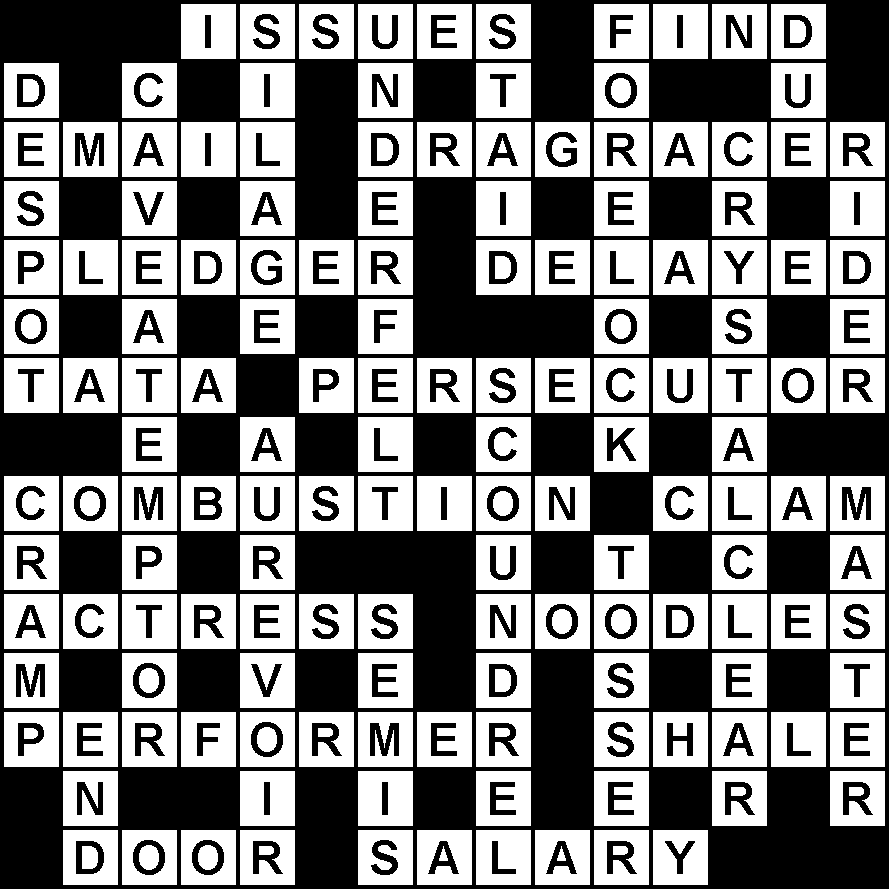
 23-across in last week’s crossword is a little “out of character” for a Stickler puzzle. I put it in there on purpose to give me something to write about this week (sort of). The clue, A clock, one with a particular role? (7), needs the solver to treat clock as c + lock, and then find a synonym for lock . It’s a tall order, and falls into the libertarian category, that is, it disobeys standard language rules, forcing the solver to basically process the “word” (and processing it the right way to make the clue work) before actually using it in a clue. However, if I do this sort of thing (and I don’t very often), it will always be accompanied by a “?” (my “language abuse” warning) as I believe it’s my duty to warn solvers when all it not as it seems (or can’t be validly taken). For me, anything less is not being fair to the solver, as such shenanigans without warning could lead to anarchy. Take a look at this clue, 14-across: Deposit stated in legal document may be held up (7) If every word could be broken down before use, then the clue could look like this: Depo + sit/Depos + it, st + ate + d/stat + ed, i+n, l + eg + a + l/ le + gal etc etc. Imagine having to look at every word in every clue this way, which is at the extreme end of libertarian clueing, but of course, without indication, every clue has to be looked at this way. That’s why I need to indicate a variation to the norm by adding a “?” (and, BTW, not including and “?” where it doesn’t apply) – after all we are playing a word game here and liberties can only go so far. Is it right for every clue to be libertarian? That’s for solvers to judge, but a crossword written that way would be a hard slog to solve and the majority of clues would only unravel after the answer has been found, defeating the whole purpose of cryptics IMO.
It should be noted that libertarian setting is much easier than traditional Ximenean clueing as each word potentially has more options for the setter. Often such setting is seen as more creative, yet the setter has more tools to play with and is making it easier for themselves by using this style.
I’m happy to hear your feedback on this type of thing. As I said, it’s not a common thing in Stickler crosswords and it is indicated, so hopefully it isn’t too left-field for most solvers.
| Across | Answers and Clues | Explanations |
| 1 | ISSUES | |
| Crooked Aussies not charged with capital matters (6) | Anagram of AUSSIES minus A (capital letter) | |
| 5 | FIND | |
| Track down addict dropping ecstasy (4) | FIEND minus E | |
| 9 | ||
| Art deleted from material used incorrectly in communication (1-4) | Anagram of MATERIAL minus ART | |
| 10 | DRAG RACER | |
| Drive car backwards in gear, upset with fast competitor (4,5) | DR + (CAR reversed inside anagram of GEAR) | |
| 13 | PLEDGER | |
| Promising person quietly detailed book of accounts (7) | P + LEDGER | |
| 14 | DELAYED | |
| Deposit stated in legal document may be held up (7) | LAY inside DEED | |
| 15 | TA-TA | |
| Length of event at auditorium is so long (2-2) | evenT AT Auditorium | |
| 16 | PERSECUTOR | |
| In essence, court tortured a tormentor (10) | PER SE + anagram of COURT | |
| 19 | COMBUSTION | |
| Search rigged units containing oxygen burning (10) | COMB + anagram of UNITS outside O | |
| 20 | CLAM | |
| Very reticent person, one kept from mining land (4) | CLAIM minus I | |
| 23 | ACTRESS | |
| A clock, one with a particular role? (7) | A + C(TRESS) | |
| 25 | NOODLES | |
| Pasta, lots, offered after starter from Napoli (7) | OODLES after (N)APOLI | |
| 26 | PERFORMER | |
| Right fashion adopted by noble entertainer (9) | (R + FORM) inside PEER | |
| 28 | SHALE | |
| Marketing surrounding hard rock (5) | SALE outside H | |
| 29 | DOOR | |
| Reception or a place of entry (4) | DO + OR | |
| 30 | SALARY | |
| Authority accepting 60% of large payment for work (6) | SAY outside (LAR)GE | |
| Down | Answers and Clues | Explanations |
| 2 | SILAGE | |
| Stored fodder is blown around by wild gale (6) | IS reversed + anagram of GALE | |
| 3 | UNDERFELT | |
| Layer found at the bottom of pile? (9) | Cryptic Definition | |
| 4 | STAID | |
| Grave stone placed next to support (5) | ST + AID | |
| 5 | FORELOCK | |
| Hairy growth or otherwise ultimately carried by sheep (8) | [OR + OTHERWIS(E)] inside FLOCK | |
| 6 | DUE | |
| Proper sovereign prince deposing king (3) | DUKE minus K | |
| 7 | DESPOT | |
| Person with more than enough power to clean up mess? (6) | Double Definition – one punny | |
| 8 | CAVEAT EMPTOR | |
| Adventurer holding a casual worker to purchasing principle (6,6) | CAVER outside (A + TEMP + TO) | |
| 11 | CRYSTAL-CLEAR | |
| Announcement redirected at callers is readily understood (7-5) | CRY + anagram of AT CALLERS | |
| 12 | RIDER | |
| Contractual clause directors modified without cost (5) | Anagram of DIRECTORS minus COST | |
| 17 | SCOUNDREL | |
| Healthy relative poisoned by cold, bad egg (9) | (SOUND + REL) outside C | |
| 18 | AU REVOIR | |
| Gold ring dropped in river spoiled farewell (2,6) | AU + O inside anagram of RIVER | |
| 19 | CRAMP | |
| Confine resistance operating in military base (5) | R inside CAMP | |
| 21 | MASTER | |
| Head of school in a term reassigned teacher (6) | (S)CHOOL inside anagram of A TERM | |
| 22 | TOSSER | |
| One having a fling ordered roses after end of engagement (6) | Anagram of ROSES after ENGAGEMEN(T) | |
| 24 | SEMIS | |
| They transport cargo of cruise missiles (5) | cruiSE MISssiles | |
| 27 | END | |
| Close bends not protected by guardrails? (3) | (B)END(S) |


 Last week I mentioned that the medically-themed weekly cryptic I did for a medical publication was the hardest regular cryptic I’ve had to write due to the specific nature of medical words. The hardest non-cryptic I’ve written on a regular basis was for a Macquarie Dictionary website that offered various resources to school children. The brief was to cater for 11-15 year-olds, which sounds easy, but I can assure you this was no easy task. The difference in vocabulary on average in this age group is enormous, and if you allow for late developers and advanced students, you end up with a massive spectrum that’s hard to please across the board. There is, though, an approach that mostly works especially in an online environment that the crossword was running. I used nouns. As language develops, our knowledge of things increases gradually, but our ability to describe them increases at an alarming rate. That is, we know about a house from an early age, but the way we describe its shape, size, setting, colour, value etc comes over time as we learn more descriptive words. Therefore, an 11-year-old and 15-year-old will know HOUSE, but the 11-year-old is unlikely to know what a SEMI-DETACHED HOUSE is, where a 15-year-old might. To cover this gap in language, the key is to stick with more factual clues – objects, places, people, etc – things hopefully all the crossword’s audience know, and if they don’t know, the clue should supply enough information for them to find out. The crossword becomes essentially a specific general knowledge one. In an online environment, and using the software that I do,
  In 2006 I was contacted by a weekly medical publication about doing a medically-themed cryptic. I’ve always had problems setting a price for crosswords of all kinds – it’s not totally about the time taken to set a crossword, it’s more about what the requesting publication is prepared to pay. I think of myself as an artist of sorts, and believe that years of experience should count more than the actual hours taken to set a crossword. The medically-themed cryptic had me at a loss – the task wouldn’t be easy, but the publication itself had a relatively small circulation (compared to state-based papers and magazines), so what should I ask for? In my experience such publications expected to pay a low amount, but I needed to make sure it was worth my time and effort, especially as I was creating an online version as well as part of the deal. Before I could submit my price, though, the medical publication told me the amount they were willing to pay (it happens sometimes) which was above what would have been my asking price. Just as well, since the medically-themed cryptic which I did for a year was the hardest regular cryptic I’ve written. To put it simply, medical terminology is very precise and generally unambiguous, making the definition side of any cryptic clue hard to disguise. Using definitions like “disease” or “complaint” isn’t good enough in a clue that could point to 1000s of answers, both common and obscure. I enjoyed the challenge though and it was amazing how many medical terms were buried in the dictionary and how many common words had medical meanings. The trick with all themed crosswords is to take advantage of all elements involved: answer, surface reading, words/terms in the definition, and words/terms in the wordplay. The simple inclusion of “doctor” = DR somewhere in a clue is enough to add to a theme even though the definition and/or answer may have no medical connection at all. After a year the crossword was axed due to falling income but I learnt a lot through the experience. The publication is still going but with different owners, and times are different now – a lot less printed advertising which ultimately finances the whole enterprise. I now do just one crossword a year for them which effectively summarises a whole year’s worth of articles, featuring the main topics. It’s not cryptic, but large and I have to read 50 or so medical articles and pull out key words in order to assemble enough fodder to generate a decent grid of words. Hard work, but in an environment where there’s not a lot of work available, I’m very grateful for it.

