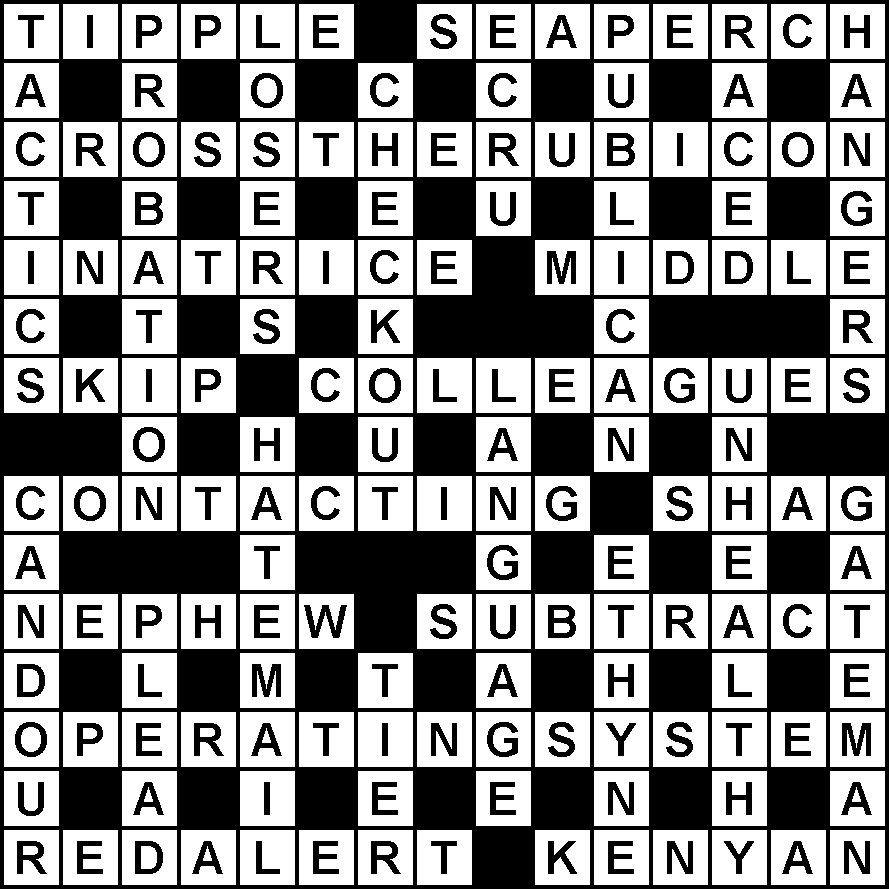
(click on the clue number to see the hint)
Click on underlined text for explanation of terms.
Need more hints for these or other clues? Just leave a reply below.
The structure of the answer involves either letters placed outside other letters, or letters placed inside other letters. Which type of container clue is determined by an appropriate container indicator.
Either a mixture of letters is placed inside or outside other letters, or letters are placed inside or outside a mixture of letters. An anagram indicator and containment indicator will be present.
The structure of the answer involves either letters placed outside other letters, or letters placed inside other letters. Which type of container clue is determined by an appropriate container indicator.
A type of clue that involves the mixing up of letters without the inclusion of a letter or letters. This clue will have an anagram indicator to signify jumbling and a subtraction indicator to signify the removal of a letter or letters.
A removed letter may be as seen in the clue, an abbreviation for a word in the clue, or the result of another cryptic device like taking the initial letter from a word. Removed letters may be a whole word as seen in a clue, the synonym of a word in the clue (if that synonym is contiguous within the anagram fodder), or the result of another cryptic device like taking the middle two letters from a word.
A type of clue that involves the mixing up of letters without the inclusion of a letter or letters. This clue will have an anagram indicator to signify jumbling and a subtraction indicator to signify the removal of a letter or letters.
A removed letter may be as seen in the clue, an abbreviation for a word in the clue, or the result of another cryptic device like taking the initial letter from a word. Removed letters may be a whole word as seen in a clue, the synonym of a word in the clue (if that synonym is contiguous within the anagram fodder), or the result of another cryptic device like taking the middle two letters from a word.
The answer is hidden among the words of the clue. No spare words should be present. A suitable hidden indicator will point to the buried text.
Examples: part of, associated with, types of.
A question mark has been used to indicate "language abuse", that is, a word or words in a clue are used in a technically incorrect way, but the meaning can be still inferred.
Example: A indeed (?) could mean to insert A inside deed.
A pointer that signifies the placing of one or more parts of a clue (or their equivalents) around the OUTSIDE of one or more parts of a clue (or their equivalents).
Examples: holding, keeping, embracing - anything that creates the image of containment.
The structure of the answer involves either letters placed outside other letters, or letters placed inside other letters. Which type of container clue is determined by an appropriate container indicator.
The answer is found by butting together parts defined in the wordplay. There may be some positional indicators that change the order of these parts.
The answer is hidden among the words of the clue. No spare words should be present. A suitable hidden indicator will point to the buried text.
Examples: part of, associated with, types of.
A word or series of words that signify a mixing-up of letters.
Examples: changed, at sea, confused, all over the place - anything that indicates change or jumbling.
The structure of the answer involves either letters placed outside other letters, or letters placed inside other letters. Which type of container clue is determined by an appropriate container indicator.
Either a mixture of letters is placed inside or outside other letters, or letters are placed inside or outside a mixture of letters. An anagram indicator and containment indicator will be present.
The structure of the answer involves either letters placed outside other letters, or letters placed inside other letters. Which type of container clue is determined by an appropriate container indicator.
A word or series of words that signify the removal of a letter, letters, word or words (or their equivalents) from other parts of the clue (or their equivalents).
Examples: taken from, decreased by, less.
The entire answer is the result of removing the first or last letter from part of the clue or its synonym. A truncation indicator will be present.


 I often get asked “Do you have a book?” or “Have you thought about writing a book?” It seems to be a natural progression for someone in a profession, especially one like crossword writing, where there are aren’t many people doing it. In 2005 I was approached by News Ltd regarding doing a book of my crosswords. At the time Fairfax were regularly publishing books of past puzzles and, not to be outdone, News Ltd wanted to put out one of their own. At the time, News didn’t publish such works themselves, they did deals with publishers willing to get involved, minimising their risk.
 Clue-writing competitions are common on the internet. There are a number of different types like the public ones run through the Google group,

