
 Some of you may know that I enjoy making sourdough. I started over 5 years ago after searching for a new hobby that had clearly defined boundaries, was not expensive and something I could share with others. It’s common when I bring a loaf to a BBQ or dinner for people to say they buy thier sourdough from the local supermarket and they are taken aback when I say that it’s unlikely to be “proper” sourdough as the process to produce it is far too labour-intensive and lengthy to fit into the usual supermarket bakery routine, where the emphasis is on mass-production to maximise profit. Proper sourdough contains flour, water and salt, and a natural culture grown from fermented flour and water that is fed with flour and water. If any other “ingredient” is present, it isn’t proper sourdough. I’ve seen vinegar listed in the ingredients which is obviously used to create a sour taste. So, where am I going and how does this relate to crosswords?
Currently there are no laws clearly defining what sourdough is, so it’s legal to call any bread sourdough no matter what the taste, texture or ingredients. It seems to me that cryptic crosswords are tarred with the same brush: you can call any crossword cryptic basically as long as it doesn’t look like a “normal” synonym-style puzzle. There’s no list of devices that must be used, no requirement for clues to make sense, no set of acceptable indicators, no need even for absolute equation between clue and answer (a suggestion will do) and no right or wrong. Just a “cryptic” label – the ingredients don’t really matter.
Recently I saw a “cryptic” crossword that appears in The Warwick Daily News. I had sought it out after reading an online article about recent changes to the newspaper’s puzzle page and the desire of a local man to teach others how to solve cryptics. It would be best described as a “skim” rather than a “full-cream” crossword, as the clues lack cryptic fat like good surface reading, indicators (that’s right, there were no indicators in most clues), device variety, cleverness of any description and precision. Despite its shortcomings, I’m loathe to call this crossword a disgrace for a number of reasons:
- Someone wrote it and obviously believes they have done a good job
- It appears in a newspaper so someone has paid money for it
- It’s written in such a way, with only a few basic devices, that people may be able to solve it without intensive tuition.
- There are people who solve this every day for which this crossword is their cryptic world, who believe this is what cryptics are all about and would be proud of their ability to solve it.
I believe this style of cryptic crossword first appeared in women’s magazines and puzzle books, with the main aim of being solvable. They wanted to use the cryptic tag but needed a way to allow ordinary solvers to finish them, as this is the main focus in such publications. As a cryptic crossword doesn’t have laws defining it, as with sourdough, it’s no good trying convince people that the Warwick Daily News puzzle isn’t a proper cryptic as it looks right and doesn’t work like a normal crossword. I feel for the local man trying to teach others how to solve with this as the local crossword – almost everything he’d say would be contradicted by what’s actually published. Here are a couple of clues (and answers) from the abovementioned crossword:
- A bright statue? (6) ASTUTE
- Our shandy may be a waterless substance (9) ANHYDROUS
- A fishy sausage (7) ABALONE
Next week I’m going to look at how and why these work despite their obviously inadequacies.
| Across | Answers and Clues | Explanations |
| 1 | PROGRESSIVE | |
| Monsters, surrounded by writhing vipers, should be moving forward (11) | OGRES inside anagram of VIPERS | |
| 9 | CHEWING | |
| Processing food, chef trimmed piece of chicken (7) | (CHE)F + WING | |
| 10 | REVIVAL | |
| Envy regularly shown in competitor’s comeback (7) | (E)N(V)Y inside RIVAL | |
| 11 | INITIATE | |
| Enjoying success, I had a meal with new member (8) | IN IT + I + ATE | |
| 12 | MISSIS | |
| Lady of the house is behind failure (6) | IS behind MISS | |
| 14 | THIN | |
| Superficial affair ended early (4) | (THIN)G | |
| 15 | INCOHERENT | |
| Native interrupted by commanding officer is rambling (10) | CO inside INHERENT | |
| 18 | CONTROLLED | |
| Disciplined kid provoked people on the internet (10) | CON + TROLLED | |
| 19 | OPEC | |
| Alliance in Europe criticised 17 suppliers? (4) | eurOPE Criticised | |
| 22 | ARCADE | |
| Race organised around commercial shopping area (6) | Anagram of RACE outside AD | |
| 24 | LET ALONE | |
| Don’t touch hooked claw found buried in shelter (3,5) | TALON inside LEE | |
| 26 | PLATOON | |
| Army unit is overly active in strategy (7) | TOO inside PLAN | |
| 27 | TESTERS | |
| Output of cryptic setters! (7) | Anagram of SETTERS | |
| 28 | PALM SPRINGS | |
| Californian resort is very quiet about offering jewellery (4,7) | PP outside ALMS + RINGS | |
| Down | Answers and Clues | Explanations |
| 1 | PRECISION | |
| Accuracy is adjusted in copiers (9) | Anagram of IN COPIERS | |
| 2 | ORIGIN | |
| Ring engineer concerned with extraction (6) | O + RIG + IN | |
| 3 | RIGHT ANGLE | |
| Part of a square rig tied with hard knot (5,5) | RIG + H + TANGLE | |
| 4 | SORE | |
| Tender process wrongly overlooking input of PCs (4) | Anagram of PROCESS minus PCS | |
| 5 | INVOICED | |
| Vino, not served properly chilled, is added to the bill (8) | Anagram of VINO + ICED | |
| 6 | EAVES | |
| Foliage separated from large overhanging part of roof (5) | LEAVES minus L | |
| 7 | SCRIPT | |
| One released by inspector forged letters (6) | Anagram of INSPECTOR minus ONE | |
| 8 | CLOSET | |
| Shut front of this small cupboard (6) | CLOSE + (T)HIS | |
| 13 | BONESETTER | |
| One is nursed by improving osteopath (10) | ONES inside BETTER | |
| 16 | EMPLOYEES | |
| Workers seem openly upset without reason ultimately (9) | Anagram of SEEM OPENLY minus REASO(N) | |
| 17 | CRUDE OIL | |
| Electrical device harnessing startling output from rig (5,3) | COIL outside RUDE | |
| 18 | CLAMPS | |
| Close electrical units with fasteners (6) | CL + AMPS | |
| 20 | CREASE | |
| Car not handling a moderate line (6) | CAR minus A + EASE | |
| 21 | RAISIN | |
| Producing, in reduced quantity, dried fruit (6) | (RAISIN)G | |
| 23 | CHAMP | |
| Crush a title holder (5) | Double Definition | |
| 25 | ENDS | |
| A passenger, pulled from wrecked sedan, passes away (4) | Anagram of SEDAN mnius A |


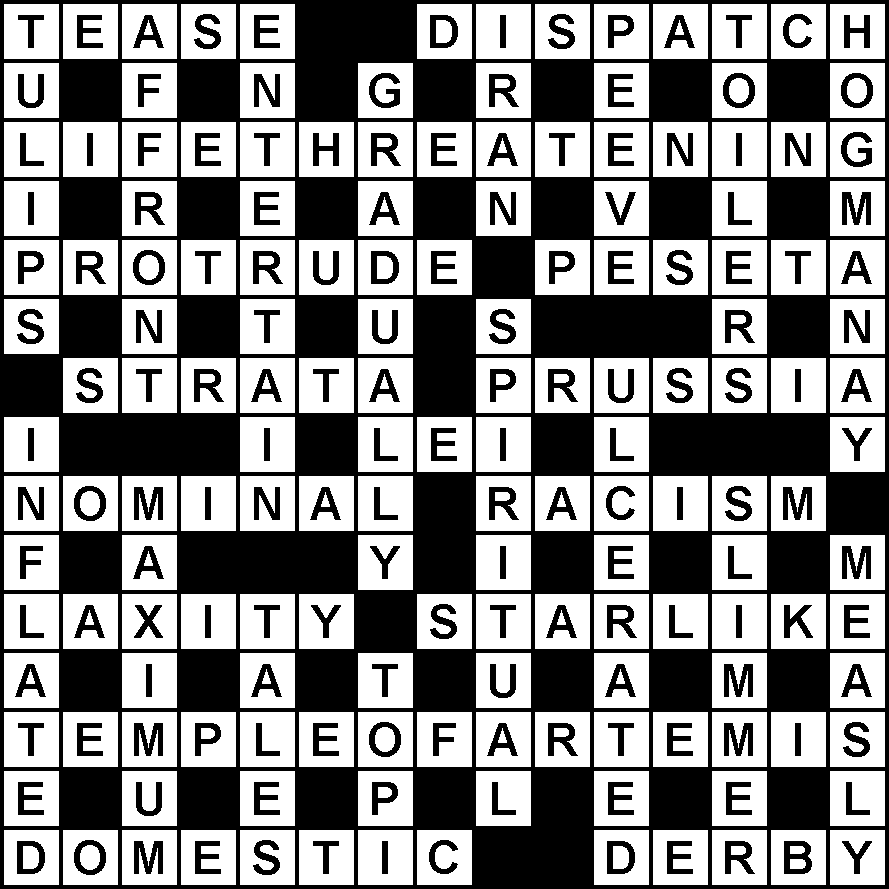 Some of you may know from various interviews I’ve done that I was introduced to cryptic crosswords by my English teacher when I was 15. He used the Guardian that was published every Sunday in NSW to teach us the ins and outs of cryptic crosswords. In fact, we would spend all week solving it and do a report at the end of the week summarising what we’d learnt. He had a huge impact on my life. As no-one in our family did cryptics I doubt I would have ever taken up solving. I look back at that time in the late 1970s, when there were only books to aid solvers, as a wondrous time. I had no preconceptions, no idea of what was normal, permitted, hard, easy, clever, sloppy or wrong – I just had a puzzle to solve and a language of sorts to learn along the way. I was 15 years old and I knew this puzzle was meant for people with wider word knowledge than me, so I expected to struggle, but as the clues were well-written with generally clear wordplays, I knew I would recognise the answer when I saw it. Solving was fun – much more fun than in this current era – as there was no choice but to chip away at the puzzle the entire week – not an arduous task because rewards eventually came with satisfaction. I can remember thumbing though an old 1962 “Book of Words”, page by page, trying to match the letter pattern I needed in the hope of finding an answer. I didn’t mind this and for all I knew it was normal. Some of the best answers came from nutting out the wordplay without actually knowing the answer word. What joy when the worked-out answer is found in the dictionary with the stated definition in the clue!
 It’s amazing out of the thousands of possible words that can fit into a grid, how often words could end up being related in some way. It’s not uncommon to have two words that are synonymous or a few words that have a medical bent etc. Of course, it’s up to the setter what words are chosen, but still, being able to create a mini-theme without really trying must be statistically difficult but it often doesn’t seem that way. It also happens sometimes that words are included that seem harmless in isolation, but when combined with others in the grid, it may appear that the setter is making some kind of statement. In a recent Australian Financial Review crossword for Christmas, I finished the grid (complete with a colourful Christmas tree inset), filled in the words and wrote the clues. In some regards doing this is routine for me, or I may be working on a number of puzzles at once, and I can forget about context. Such was the case here. I exported the finished grid, and while eying it over, I noticed I had included a five-letter religion right in the middle of the crossword at the heart of the Christmas tree. It’s just a puzzle and including that religion doesn’t mean anything, but its positioning might make people think otherwise. I quickly rearranged a few words, clued them and sent it off. No need to cause an issue if it can be avoided.

