(click on the clue number to see the hint)
Click on underlined text for explanation of terms.
Need more hints for these or other clues? Just leave a reply below.
A word or series of words that signify the loss of one letter at the start or end of a word or string of letters.
Examples: beheaded, cut short, endless, nearly, largely etc.
The answer is found by butting together parts defined in the wordplay. There may be some positional indicators that change the order of these parts.
The structure of the answer involves either letters placed outside other letters, or letters placed inside other letters. Which type of container clue is determined by an appropriate container indicator.
The structure of the answer involves either letters placed outside other letters, or letters placed inside other letters. Which type of container clue is determined by an appropriate container indicator.
A pointer that signifies the placing of one or more parts of a clue (or their equivalents) around the OUTSIDE of one or more parts of a clue (or their equivalents).
Examples: holding, keeping, embracing - anything that creates the image of containment.
The answer is found by butting together parts defined in the wordplay. There may be some positional indicators that change the order of these parts.
The answer is hidden among the words of the clue. No spare words should be present. A suitable hidden indicator will point to the buried text.
Examples: part of, associated with, types of.
The answer is found by butting together parts defined in the wordplay. There may be some positional indicators that change the order of these parts.
A type of clue that involves the mixing up of letters without the inclusion of a letter or letters. This clue will have an anagram indicator to signify jumbling and a subtraction indicator to signify the removal of a letter or letters.
A removed letter may be as seen in the clue, an abbreviation for a word in the clue, or the result of another cryptic device like taking the initial letter from a word. Removed letters may be a whole word as seen in a clue, the synonym of a word in the clue (if that synonym is contiguous within the anagram fodder), or the result of another cryptic device like taking the middle two letters from a word.
The entire answer is the result of removing the first or last letter from part of the clue or its synonym. A truncation indicator will be present.
The clue has two parts, each one defining the answer without using cryptic devices. Ideally each definition should have no etymological relationship.
The answer is hidden among the words of the clue. No spare words should be present. A suitable hidden indicator will point to the buried text.
Examples: part of, associated with, types of.
A word or series of words that signify a mixing-up of letters.
Examples: changed, at sea, confused, all over the place - anything that indicates change or jumbling.
A word or series of words that signify the turning around (across & down clues), or overturning (down clues only) of letters.
Examples: upset, reversed, retired, in withdrawal, over etc.
A word or series of words that signify a mixing-up of letters.
Examples: changed, at sea, confused, all over the place - anything that indicates change or jumbling.
The structure of the answer involves either letters placed outside other letters, or letters placed inside other letters. Which type of container clue is determined by an appropriate container indicator.
A question mark has been used to indicate "language abuse", that is, a word or words in a clue are used in a technically incorrect way, but the meaning can be still inferred.
Example: A indeed (?) could mean to insert A inside deed.
A word or series of words that signify the loss of one letter at the start or end of a word or string of letters.
Examples: beheaded, cut short, endless, nearly, largely etc.
The structure of the answer involves either letters placed outside other letters, or letters placed inside other letters. Which type of container clue is determined by an appropriate container indicator.
The answer is found by butting together parts defined in the wordplay. There may be some positional indicators that change the order of these parts.

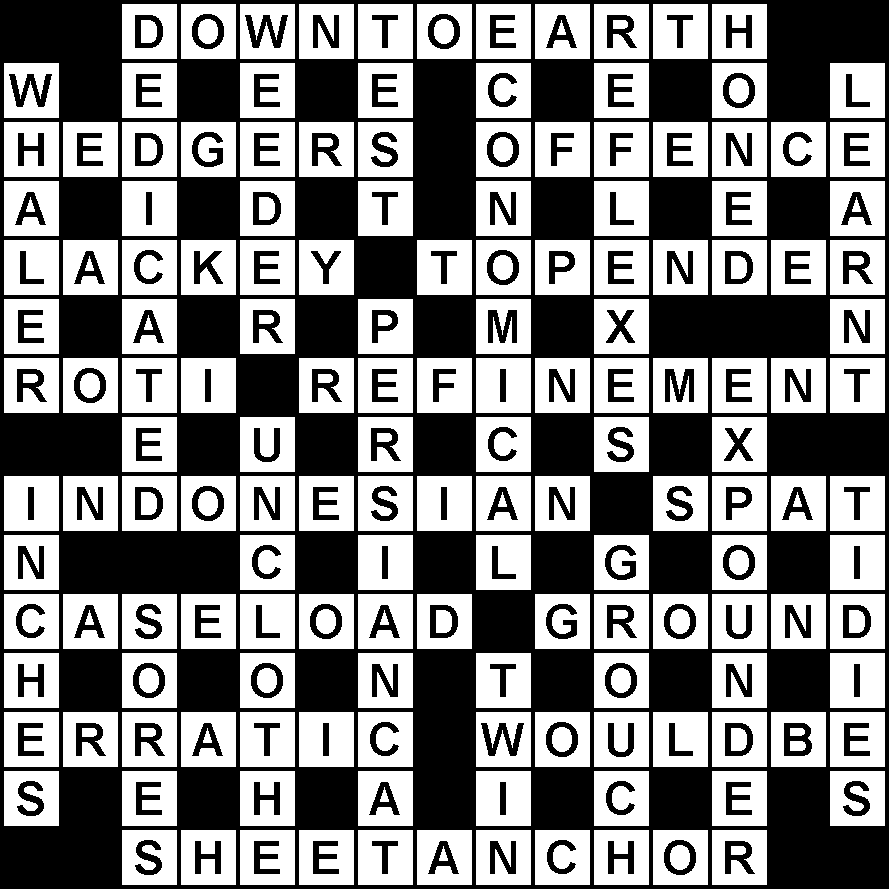 I’d like to talk this week about choices made by setters when writing a clue. We’ve established before that setters can take the construction of a clue like 15-across in this puzzle: Upstanding people accepted by retired gentility (10). [FINE + MEN inside RET giving REFINEMENT] This clue could be Upstanding men accepted by retired gentility (10) or simply Fine men accepted by retired gentility (10). Very little effort is needed to make it easy, moderate or hard by just replacing a few words. The clue ultimately used reflects the choice of the setter, that is, whether a setter wants that particular clue to be easy, moderate or hard. This choice may be made to keep the whole crossword consistent in difficulty or possibly to present a balanced grid (that is, some may be hard, others easy and some somewhere in between).


 One of the things my old neighbour asked me about was what he called “order of operation”, that is the sequence a solver takes when processing a wordplay. His main question related to whether a clue that flowed left to right with no assumed word groupings (imagined brackets) was superior to a clue where assumptions needed to be made. Here’s an example of each from last week’s crossword: 1) 19-across Call about right to join card game (8,6). 2) 12-across Bond managed by head of taxation in suspicious circumstances (8). The first one can be taken from left to right processing exactly as is stated in the clue; the second one requires the solver to join two elements and put them inside another. The second one has another parsing possible, so the solver must work out which one is in effect. As a setter and solver, I see the work needed to be done by the solver here to be part of the game, same as working out, for example, whether a word is part of a device or fodder, and what word form a particular word takes. When I’m setting, any assumptions will involve groups of words, but the order will always be left to right unless the wordplay contains positional indicators that say otherwise. I might include punctuation to mislead, but I won’t leave punctuation out that potentially changes the order in which indicators operate. That is, an operating adjective will appear ahead of its fodder, not behind it with an implied comma (as is commonly seen in modern-day cryptics). Clues like A B in, where what is really meant is A with B in, will never appear in a Stickler. I think this is where order of operation can create convoluted clues: a combination of implied bracketed wordplay and indicators operating out of order. Clear as mud? So, which is superior, 1) or 2)? In this case, I see them as basically both the same, and although 1) might be seen as being easier, 2) certainly doesn’t present many problems.

