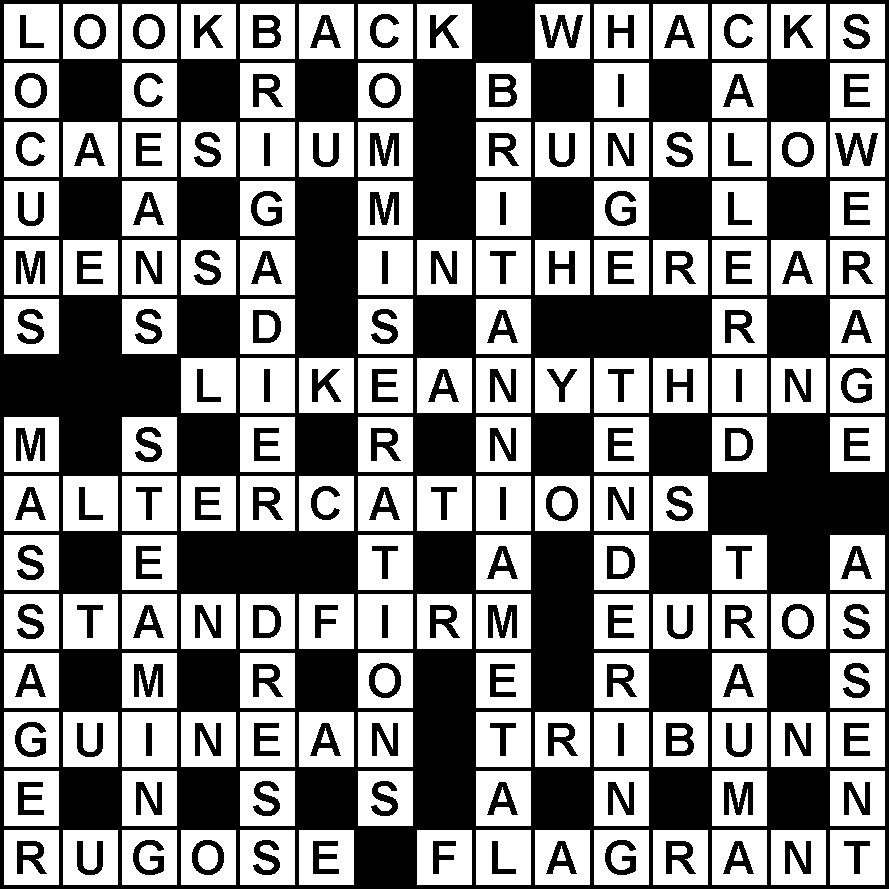
The Stickler Weekly 123 Overseas Help

Welcome all cryptic crossword solvers.

Some cryptic crosswords are tough purely because local lingo is used and not understood by all, especially those living outside of Australia. This post seeks to fill this vernacular gap.

There aren’t any extra hints needed this week.

Like to add something I’ve missed to help others, or comment on a meaning, term or expression? Please leave a reply below.

Posted in Stickler Weekly Clue Help, The Stickler | Tagged , , | Comments Off on The Stickler Weekly 123 Overseas Help

The Stickler Weekly 122 Solution

Last week an Australian Financial Review (AFR) cryptic solver, Martin Smith, posted about elements of recent AFR cryptic that he wasn’t happy with. His main beef was the use of unusual or unknown words, causing him to be disappointed by my efforts. It turned out that there were three words, one in each of the last three AFR cryptics that he didn’t know and had failed his test of acceptance, a generic program called spellcheck. I responded privately to the poster, in essence saying that it wasn’t possible to write crosswords at any level with a guarantee that all solvers would know all the answers. In fact, that tended not to matter anyway because thankfully cryptic clues almost always give you two ways to get an answer, and a well-written wordplay can get you there even if you don’t know the word! This was key for me as a teenager doing the Guardian – I didn’t know half the answer words but was still able to nut out the answers. For me, and I suspect, a large number of people, solving from the wordplay alone is a real buzz and one of the joys of being a cryptic solver. As a setter, I know I’ve done my job well if someone says they found the answer through the wordplay and learnt a new word. Two of the three concerned poster’s unusual/unknown words (BISHOPRIC, IGUANODON) are in my concise dictionaries and the other word (CAMELEER) is in all my references. As far as spellcheck goes, it varies from app to app, so it didn’t surprise me to find the word he complained about the most (IGUANODON) passed the MS Word spellcheck on my PC. I’m very careful about the words I use in any puzzle, making sure that the overall result has some kind of balance. As the AFR is a weekly puzzle, there’s more scope in this area as in theory solvers have lots of time to work things out. However, a setter can go overboard in this area, as regularly happens with the Sun-Herald‘s cryptic crossword, written, I believe, by Russel Jessop based on his father’s (Noel Jessop) collection of clues. The result is a strange mixture of clues and some really obscure answers, including some that only appear in Chambers. Here are some answers from last week’s crossword: ONAGERS, DYAK, AMERCED, YESKS, and THEA. Martin Smith wouldn’t like this crossword at all!
It’s not uncommon for the odd solver to complain about something I’ve done, often, I think, they are annoyed they couldn’t work out an answer without help, but this post had more to it. The poster listed their age as 26, and I started to wonder whether this person might be considered part of a modern-age group of solvers, with their main tool a mobile phone or tablet. I imagine the modern solver to be time-poor, keen to finish the crossword in one sitting – none of this take all week to solve it or chip away at it for a number of days. This would explain the lack of patience in working on the wordplays to find answers. They also have various online and maybe app tools available to look things up or find a list of possible answers through letter pattern-matching software. This would explain the use of “spellcheck” as a word-guide and the “cheating” that the poster felt they needed to do to get the answers. It’s also possible they grew up solving crosswords that had clues with poor wordplays and most of the answers were derived from definitions alone. Don’t get me wrong here, I’m not criticising the poster’s approach, just that it seems the modern solver thinks of cryptic clues in a different way and has a different approach to solvers in the past. This is something I have to ponder and adjust to if I want my crosswords to continue to be relevant.

Across Answers and Clues Explanations
1 HAILSTORM
Violent weather damage seen around lot is scattered (9) HARM outside anagram of LOT IS
6 SIGHT
Express disappointment with time display (5) SIGH + T
9 OSTIA
Small openings in case kept from new associate (5) Anagram of ASSOCIATE minus CASE
10 ESTAMINET
Cafe established a storehouse close to market (9) EST + A + MINE + MARKE(T)
11 LEADERS
Directors rewound small roll of film containing commercial (7) (S + REEL) reversed outside AD
12 BLOWER
Bishop put down fan, say (6) B + LOWER
14 EMANATES
Issues set a celebrity back (8) (SET + A + NAME) reversed
15 STUN
Shock performance that’s dangerous to a great extent (4) (STUN)T
18 POOP
Go back to ship (4) Double Definition
19 PORTRAIT
Photograph train nearly inside transit terminal (8) (TRAI)N inside PORT
22 TASERS
Breasts served cooked after starter – they are stunning (6) Anagram of B(REASTS)
23 EYEWEAR
Are we roughly handling the old glasses, say? (7) Anagram of ARE WE outside YE
25 FIRE ALARM
Warning device – one actually existing in farm (4,5) (I + REAL) inside FARM
26 POINT
Feature grass around home (5) POT outside IN
27 LAPSE
Indiscretion does the rounds before end of marriage (5) LAPS + MARRIAG(E)
28 GUNPOWDER
POW kept in back section of stalag covered by explosive (9) POW inside [STALA(G) + UNDER]
 Down  Answers and Clues Explanations
1 HOOPLA
Polo played inside has endless razzle-dazzle? (6) Anagram of POLO inside (HA)S
2 INTRAVENOUS DRIP
Drug supplier, in drug-induced state, pushed around greedy detective (11,4) IN + TRIP outside (RAVENOUS + D)
3 SPACE BAR
Fine boxer’s start in fight is key for creating an opening (5,3) [ACE + (B)OXER] inside SPAR
4 OPEN SEASON
After operation, see an excited child killing time (4,6) (Anagram of SEE AN after OP) + SON
5 MYTH
Members of academy that fabricated story (4) acadeMY THat
6 SAMPLE
Last portion of haggis, more than enough to try (6) HAGGI(S) + AMPLE
7 GONE WITH THE WIND
8/10 who tumbled twist in classic movie? (4,4,3,4) Anagram of EIGHT TEN WHO + WIND
8 TUTORING
Computing pioneer taking to education (8) TURING outside TO
13 WEATHERMAN
A large mass of warm air checked by new, upstanding forecaster (10) [A + (THERMA)L] inside (NEW reversed)
16 SPITEFUL
Throw out contaminated fuel motivated by malice (8) SPIT + anagram of FUEL
17 FACE UP TO
Accept brewed cup of tea (4,2,2) Anagram of CUP OF TEA
20 ARCANE
Hidden bend, an exit primarily (6) ARC + AN + (E)XIT
21 WRITER
A character in war replaced by ceremonial author (6) A from WAR replaced by RITE
24 PANG
Heartless pig admitting an emotion that’s painful? (4) (P)I(G) outside AN


Posted in Stickler Weekly Solutions, The Stickler | Tagged , , | 6 Comments

The Stickler Weekly 122

The Stickler for this week is now available. Please select your preferred solving format.

The solution to this puzzle will appear next week.

  Clue Hints for The Stickler Weekly 122
  Overseas Help for The Stickler Weekly 122
  Solution to The Stickler Weekly 121
  Invest in the Future of The Stickler

Please include comments or discussion about this crossword below.
Request help in the Clue Hints blog entry so all can see.

It’s a weekly crossword, so please don’t give/discuss any full answers until the solution is posted (such posts will be deleted/edited).

Enjoy!

The Stickler

Posted in Stickler Weekly Puzzles, The Stickler | Tagged , , , | 1 Comment

The Stickler Weekly 122 Clue Hints

(click on the clue number to see the hint)

Click on underlined text for explanation of terms.

Need more hints for these or other clues? Just leave a reply below.


1-across


10-across

11-across

14-across


23-across


28-across

1-down

2-down

3-down

4-down

7-down

8-down

13-down

16-down


Either a mixture of letters is placed inside or outside other letters, or letters are placed inside or outside a mixture of letters. An anagram indicator and containment indicator will be present.
A type of clue that involves the mixing up of letters without the inclusion of a letter or letters. This clue will have an anagram indicator to signify jumbling and a subtraction indicator to signify the removal of a letter or letters.

A removed letter may be as seen in the clue, an abbreviation for a word in the clue, or the result of another cryptic device like taking the initial letter from a word. Removed letters may be a whole word as seen in a clue, the synonym of a word in the clue (if that synonym is contiguous within the anagram fodder), or the result of another cryptic device like taking the middle two letters from a word.

The answer is found by butting together parts defined in the wordplay. There may be some positional indicators that change the order of these parts.
A word or series of words that signify the turning around (across & down clues), or overturning (down clues only) of letters.

Examples: upset, reversed, retired, in withdrawal, over etc.

The entire answer is found by reversing part of the clue, or a synonym for part of the clue. A suitable reversal indicator will be present.
The entire answer is the result of removing the first or last letter from part of the clue or its synonym. A truncation indicator will be present.
The clue has two parts, each one defining the answer without using cryptic devices. Ideally each definition should have no etymological relationship.
The structure of the answer involves either letters placed outside other letters, or letters placed inside other letters. Which type of container clue is determined by an appropriate container indicator.
The answer is a jumbling of letters except for the initial or final letter of the anagram fodder. An anagram indicator and truncation indicator will be present.
A pointer that signifies the placing of one or more parts of a clue (or their equivalents) around the OUTSIDE of one or more parts of a clue (or their equivalents).

Examples: holding, keeping, embracing - anything that creates the image of containment.

The structure of the answer involves either letters placed outside other letters, or letters placed inside other letters. Which type of container clue is determined by an appropriate container indicator.
A word or series of words that signify a mixing-up of letters.

Examples: changed, at sea, confused, all over the place - anything that indicates change or jumbling.

The structure of the answer involves either letters placed outside other letters, or letters placed inside other letters. Which type of container clue is determined by an appropriate container indicator.
A word or phrase that defines the answer. All cryptic clues usually have a minimum of one definition which will be located at the beginning or end of the clue.
A pointer that signifies the placing of one or more parts of a clue (or their equivalents) around the OUTSIDE of one or more parts of a clue (or their equivalents).

Examples: holding, keeping, embracing - anything that creates the image of containment.

A word or series of words that signify a mixing-up of letters.

Examples: changed, at sea, confused, all over the place - anything that indicates change or jumbling.

The answer is found by butting together parts defined in the wordplay. There may be some positional indicators that change the order of these parts.
Posted in Stickler Weekly Clue Help, The Stickler | Tagged , , , | Comments Off on The Stickler Weekly 122 Clue Hints

The Stickler Weekly 122 Overseas Help

Welcome all cryptic crossword solvers.

Some cryptic crosswords are tough purely because local lingo is used and not understood by all, especially those living outside of Australia. This post seeks to fill this vernacular gap.

There aren’t any extra hints needed this week.

Like to add something I’ve missed to help others, or comment on a meaning, term or expression? Please leave a reply below.

Posted in Stickler Weekly Clue Help, The Stickler | Tagged , , | Comments Off on The Stickler Weekly 122 Overseas Help

The Stickler Weekly 121 Solution

When I first joined the Australian Crossword Club (ACC) in the early 1990s, there were some super solvers in the group, ones that never made a mistake with their answers to the monthly crosswords in the ACC’s publication, CrOzworld. I asked one of them at an annual get-together if they’d ever had a go at writing clues instead of solving them, and the response was an emphatic “no”, stating that she wouldn’t know where to start. I think most solvers “have a go” maybe with the odd original clue or by trying to improve on somebody else’s clue, but very few solvers have the mind to take a word and reconstruct it as coherent pieces rather than just put the pieces together. It does take practice and trial and error, of course, but it is a different way of thinking.
I regularly get asked about the crosswords I solve and my crossword-solving ability, and recently this started me thinking whether all good setters are good solvers and whether all good solvers would make good setters. The latter I’ve answered, no, being a good solver isn’t a guarantee that you’d write good cryptics, however, I do believe the former is true: good setters invariably are good, if not great, solvers. First, most newbie setters take the plunge largely because solving has become too easy for them, and they are looking for something more from the hobby – it’s not a natural progression though, just as an avid reader rarely has a go at writing. Setters and solvers need to be able to view a word as its components, but a setter must also be able to manufacture a grammatical process to put the components together to form an answer. Only those with an excellent understanding of the workings of cryptic clues can do this – that is, experienced solvers.
I’m happy to be challenged on this – do you know a good setter who confesses that they aren’t (or once were) a good solver?

Across Answers and Clues Explanations
1 CHIPBOARD
Reconstructed wood in box mostly wrapped in stiff paper (9) [HIP + (BO)X] inside CARD
6 DOPED
Rabbit, injected with phosphorus, died on grass, say (5) P inside DOE + D
9 TIPSTER
Forecaster’s additional information associated with time in bank (7) (PS + T) inside TIER
10 SEVILLE
City reflected the Spanish people (7) (EL + LIVES) reversed
11 GOTCHA
I understand symbol of acceleration shown next to fluctuating tacho (6) G + anagram of TACHO
12 COLLATED
Ordered bitter brought around nearly at the end (8) COLD outside LATE
13 RISERS
Promoted people – they shouldn’t forget missing memo (6) MEMORISERS minus MEMO
15 MANORS
Tract of low, wet land largely containing no large estates (6) (MARS)H outside NO
18 PACERS
Pony primarily races broken horses trained for racing (6) (P)ONY + anagram of RACES
19 ASCENT
Climbing a track (6) A + SCENT
21 TIRESOME
Ordinary variety of rose planted in season (8) Anagram of ROSE inside TIME
22 ZIPPER
Go for a fly (6) ZIP + PER
25 HIT LIST
Unbound title located in this assorted collection of targeted items? (3,4) T(ITL)E inside anagram of THIS
26 EXPLORE
Look into international show not totally sticking to traditions (7) (EXP)O + LORE
27 SPRIG
Season lacking new growth (5) SPRING minus N
28 CAPARISON
Elaborate clothing from a European capital, pinched by crook (9) (A + PARIS) inside CON
 Down  Answers and Clues Explanations
1 CATEGORY
Class pet, for example, or first to yield? (8) CAT + EG + OR + (Y)IELD
2 INPUT
Characters exposed by set-up nicked withdrawn contributions (5) seTUP NIcked reversed
3 BATCH PROCESSING
Computer work begins to crash PC needing new configuration (5,10) Anagram of BEGINS TO CRASH PC
4 AFRO
A Frenchman coarsely trimmed thick curly hair (4) A + (FRO)G
5 DISLOYAL
False idols of the people retired faithless (8) Anagram of IDOLS + (LAY reversed)
6 DEVIL-WORSHIPPER
Satanist controversy was brought up by dispatcher (5-10) (ROW + LIVED) reversed + SHIPPER
7 POLITESSE
Complicated sites restricted by European protocol (9) Anagram of SITES inside POLE
8 DREADS
Head of Demonology studies fears (6) (D)EMONOLOGY + READS
14 SUPERSTAR
Damn agent, American, upset somebody (9) (RATS + REP + US) reversed
16 AROMATIC
Sweet-smelling carnation finally given away by a loving person (8) A + [ROMANTIC minus CARNATIO(N)]
17 STURGEON
Theatre worker securing market’s last supplier of caviar (8) SURGEON outside MARKE(T)
20 ITCHES
Iodine put on infected chest causes irritation (6) I + anagram of CHEST
23 POOLS
Sailing vessel passed around small bodies of water (5) SLOOP reversed
24 KEEP
Observe gander with tail in air (4) PEEK reversed


Posted in Stickler Weekly Solutions, The Stickler | Tagged , , | 2 Comments

The Stickler Weekly 122 Delayed

I’m running late this week. A new Stickler Weekly and last week’s solution will appear tomorrow.

The Stickler

Posted in Stickler Weekly Puzzles, The Stickler | Tagged , , , | Comments Off on The Stickler Weekly 122 Delayed

The Stickler Weekly 121

The Stickler for this week is now available. Please select your preferred solving format.

The solution to this puzzle will appear next week.

  Clue Hints for The Stickler Weekly 121
  Overseas Help for The Stickler Weekly 121
  Solution to The Stickler Weekly 120
  Invest in the Future of The Stickler

Please include comments or discussion about this crossword below.
Request help in the Clue Hints blog entry so all can see.

It’s a weekly crossword, so please don’t give/discuss any full answers until the solution is posted (such posts will be deleted/edited).

Enjoy!

The Stickler

Posted in Stickler Weekly Puzzles, The Stickler | Tagged , , , | Comments Off on The Stickler Weekly 121

The Stickler Weekly 121 Clue Hints

(click on the clue number to see the hint)

Click on underlined text for explanation of terms.

Need more hints for these or other clues? Just leave a reply below.


1-across

6-across

9-across

12-across


15-across

21-across


25-across

26-across

27-across

28-across

1-down


4-down

5-down

7-down

14-down


17-down


The structure of the answer involves either letters placed outside other letters, or letters placed inside other letters. Which type of container clue is determined by an appropriate container indicator.
A word or phrase that defines the answer. All cryptic clues usually have a minimum of one definition which will be located at the beginning or end of the clue.
The structure of the answer involves either letters placed outside other letters, or letters placed inside other letters. Which type of container clue is determined by an appropriate container indicator.
The answer is found by removing a letter, letters, or a word (either found directly in the clue or derived) from a word or words (or their synonyms). Subtractions involving synonyms must be done with contiguous letters, that is, a word will subtract directly unless specifically indicated. A subtraction indicator is present to initiate the action.
Either a mixture of letters is placed inside or outside other letters, or letters are placed inside or outside a mixture of letters. An anagram indicator and containment indicator will be present.
The answer is found by butting together parts defined in the wordplay. There may be some positional indicators that change the order of these parts.
A question mark has been used to indicate "language abuse", that is, a word or words in a clue are used in a technically incorrect way, but the meaning can be still inferred.

Example: A indeed (?) could mean to insert A inside deed.

A pointer that signifies the placing of one or more parts of a clue (or their equivalents) around the OUTSIDE of one or more parts of a clue (or their equivalents).

Examples: holding, keeping, embracing - anything that creates the image of containment.

The answer is found by butting together parts defined in the wordplay. There may be some positional indicators that change the order of these parts.
The answer is hidden inside the clue in reverse order. There are two indicators: one to signify that a hidden word is present; the other to reverse the letters.
The entire answer can be discovered by mixing up letters. An appropriate anagram indicator will be present.
A word or series of words that signify the loss of one letter at the start or end of a word or string of letters.

Examples: beheaded, cut short, endless, nearly, largely etc.

Either a mixture of letters is placed inside or outside other letters, or letters are placed inside or outside a mixture of letters. An anagram indicator and containment indicator will be present.
The answer is found by removing a letter, letters, or a word (either found directly in the clue or derived) from a word or words (or their synonyms). Subtractions involving synonyms must be done with contiguous letters, that is, a word will subtract directly unless specifically indicated. A subtraction indicator is present to initiate the action.
The structure of the answer involves either letters placed outside other letters, or letters placed inside other letters. Which type of container clue is determined by an appropriate container indicator.
The entire answer is found by reversing part of the clue, or a synonym for part of the clue. A suitable reversal indicator will be present.
Posted in Stickler Weekly Clue Help, The Stickler | Tagged , , , | Comments Off on The Stickler Weekly 121 Clue Hints

The Stickler Weekly 121 Overseas Help

Welcome all cryptic crossword solvers.

Some cryptic crosswords are tough purely because local lingo is used and not understood by all, especially those living outside of Australia. This post seeks to fill this vernacular gap.

There aren’t any extra hints needed this week.

Like to add something I’ve missed to help others, or comment on a meaning, term or expression? Please leave a reply below.

Posted in Stickler Weekly Clue Help, The Stickler | Tagged , , | Comments Off on The Stickler Weekly 121 Overseas Help